
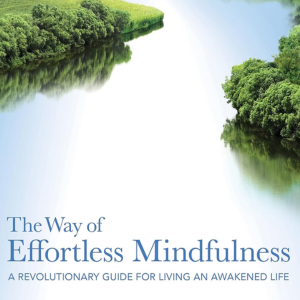
Can mindfulness feel less like a chore and more like a natural way of living? In The Way of Effortless Mindfulness: A Revolutionary Guide for Living an Awakened Life, meditation teacher Loch Kelly challenges the idea that inner peace requires hours of rigid mental discipline. Instead, he presents a direct path rooted in open-hearted awareness, accessible through brief, micro-moments across everyday life.
In this review, we examine the book’s core concepts, the mechanics of its glimpse practices, its practical benefits, and its notable limitations. Whether you are struggling with traditional breath counting or seeking a contemporary perspective on non-dual contemplative wisdom, this guide will help you determine if Loch Kelly’s approach fits your personal journey.
Detail | Information |
Book | The Way of Effortless Mindfulness: A Revolutionary Guide for Living an Awakened Life |
Author | Loch Kelly |
Published | 2019 |
Publisher | St. Martin’s Publishing Group |
Length | 216 pages (publisher listing) |
Best suited for | Readers interested in mindfulness, open awareness, and direct contemplative practice |
Table of Contents
ToggleBook Overview: The Way of Effortless Mindfulness
Loch Kelly brings a unique blend of training to this work. As a licensed psychotherapist and recognized non-dual meditation teacher who studied under both Tibetan Buddhist masters and Western psychological mentors, Kelly bridges modern cognitive understanding with ancient contemplative frameworks.
The book is arranged around an experiential arc often described across three developmental stages: discovering awareness, unfolding its qualities, and abiding within it amidst everyday routines. Rather than presenting a dry academic thesis, Kelly keeps the text focused on short, experiential pointers designed to help readers shift perspective in the middle of active daily life.
What Is Effortless Mindfulness?
Most modern mindfulness traditions emphasize deliberate concentration, where you constantly tether attention to a specific anchor, such as the breath, physical sensations, or an ambient sound. When your mind wanders, you gently pull it back. While valuable, this technique can sometimes feel like strenuous cognitive work.
Kelly proposes an alternative approach called “effortless mindfulness.” Here, the goal is not to control or narrow your focus, but to discover that awareness is already spacious, calm, and naturally present. Instead of building calm through sustained mental effort, you learn to step back and rest in the clarity that already exists underneath active thinking.
The Main Ideas in Loch Kelly’s Book
Open-Hearted Awareness
Kelly emphasizes that authentic awareness is not cold, detached, or merely intellectual. Instead, he describes awareness as intrinsically open-hearted—a welcoming state that naturally embodies warmth, empathy, and emotional connection. When we cease over-identifying with our internal critical chatter, compassion ceases to be a forced mental duty and instead becomes a spontaneous, natural way of meeting ourselves and others.
Glimpse Practices
The cornerstone of Kelly’s practical method is the concept of “small glimpses, many times.” Rather than urging readers to isolate themselves on a meditation cushion for forty-five minutes, Kelly offers dozens of micro-inquiries lasting anywhere from a few seconds to a couple of minutes. These micro-practices are deliberately designed to be woven into ordinary situations—like waiting in line, sitting at your desk, or walking between meetings.
Non-Dual Awareness
Drawing from traditions such as Dzogchen and Advaita Vedanta, Kelly frames consciousness without a rigid divide between the “observer” and the “observed.” In ordinary mental functioning, we perceive life through an internal voice that feels like a separate, isolated self inside our heads. Non-dual awareness dissolves that felt boundary, allowing life and consciousness to be experienced as an interconnected, unified whole.
Embodied Presence
A frequent pitfall in non-dual philosophy is mental dissociation, where practitioners inadvertently retreat into an ungrounded, detached headspace. Kelly guards against this trap by insisting on embodied presence. He provides direct exercises to guide attention down from mental concepts into the heart, gut, and entire physical body, ensuring that open awareness stays firmly grounded in daily physical life.
Practical Effortless Mindfulness Exercises
To understand how open awareness operates without overcomplicating it, try this simple introductory reflection.
Note: This is an accessible, original exercise inspired by open-awareness principles, rather than an exact, verbatim transcript from Loch Kelly’s book. It is not an instant cure for emotional distress, but an invitation to gently explore attention.
- Pause comfortably: Sit or stand in a relaxed posture where your body feels supported, alert, and safe.
- Notice the sensory field: Without straining, observe the physical sensations in your body, the hum of room sounds, and the natural flow of breathing.
- Widen your focus: Rather than concentrating exclusively on the breath, allow attention to soften and encompass the wider environment all around you.
- Rest without striving: Notice what happens when you stop managing your experience for just thirty seconds. If your focus narrows or drifts into thinking, gently notice it without criticism.
- Check in: Notice how the space of mind feels right now—whether light, neutral, curious, or busy.
Effortless Mindfulness vs Traditional Meditation
Dimension | Traditional Focused Mindfulness | Effortless Mindfulness (Kelly’s Approach) |
Primary Mechanism | Sustained concentration on a specific object (breath, sound, mantra). | Shifting into the open, awake space that surrounds all objects. |
Effort Level | Active mental stamina and recurrent redirection of focus. | Relaxing mental strain; stepping into existing awareness. |
Session Format | Usually structured, sitting sessions (20–45 minutes). | Short “glimpse” inquiries (10–60 seconds) repeated throughout the day. |
Perceived Goal | Calming the mind, reducing stress, developing mental discipline. | Awakening to the already-peaceful nature of consciousness. |
Both methods offer real value. Focused meditation is exceptional for building basic attention stability, while effortless mindfulness helps prevent meditation from becoming rigid, stressful, or isolated from daily living.
Related Articles
What I Liked About the Book
Kelly excels at demystifying esoteric Eastern contemplative philosophies, translating complex Sanskrit and Tibetan concepts into plain, accessible language for contemporary Western readers. His warm, encouraging tone ensures the text feels conversational rather than dogmatic.
The standout feature is undoubtedly the sheer variety of glimpse practices. Because human minds process attention differently, a pointer that clicks instantly for one person might feel completely confusing to another. Kelly’s collection gives readers numerous creative avenues to experiment with until they find an entry point that genuinely resonates.
Limitations and Who Should Read It
While innovative, the book is not without hurdles. Absolute meditation beginners may find some micro-inquiries abstract or confusing, particularly prompts asking you to “look from awareness at what is aware.” Those who lack foundational mental focus may benefit from first practicing basic breath awareness before tackling non-dual shifts.
Readers should also approach scientific references with balanced expectations. While Kelly connects his ideas to contemporary neuroscience, readers should view these discussions as conceptual hypotheses rather than peer-reviewed clinical proof that this specific method eliminates psychological suffering.
This book is best suited for:
- Intermediate meditators feeling trapped by rigid, boring, or laborious routines.
- Contemplatives drawn to non-dual wisdom (such as Advaita or Dzogchen) who want practical, down-to-earth tools.
- Readers curious about integrating mindfulness seamlessly into busy workdays.
Final Verdict: Is the Book Worth Reading?
The Way of Effortless Mindfulness is a refreshing, practical contribution to contemporary mindfulness literature. Loch Kelly manages to take non-dual awareness off the mountaintop and place it squarely in the middle of modern everyday life.
If you are open to shifting how you view your own mind, the book is well worth reading. Kelly’s bite-sized glimpse practices offer a sustainable, compassionate way to step off the treadmill of overthinking and rediscover calm in the middle of an ordinary day.
FAQs
1. What exactly is “effortless mindfulness” and how does it differ from traditional meditation?
Traditional meditation often involves a lot of focused effort to control the mind. In contrast, effortless mindfulness is about shifting from your thinking mind into an open-hearted awareness that is already present. It’s not something you “do”—it’s a natural state you simply drop into, allowing you to experience clarity and calm without having to strain or work for it.
2. Can I really practice effortless mindfulness while going about my busy daily life?
Absolutely! That is the beauty of it. Because this approach doesn’t require you to sit still or close your eyes, you can practice it anywhere—while working, driving, or chatting with friends. By learning to access this “awake awareness” in short, repeated glimpses, you can stay centered, present, and compassionate throughout even your most hectic and stressful days.
3. Do I need to be an experienced meditator to benefit from this guide?
Not at all. In fact, people who have struggled with traditional meditation often find this approach much more accessible. You don’t need years of practice to start. The revolutionary guide is designed to help anyone—beginner or advanced—recognize their own inherent, peaceful nature. It’s less about training your brain and more about uncovering a deeper, quieter level of consciousness that is always there.
4. How can effortless mindfulness help me manage stress and anxiety?
When we are stressed, we are usually caught in a loop of repetitive, anxious thinking. Effortless mindfulness helps you “unhook” from those stressful stories by shifting your perspective to a wider, more spacious awareness. Instead of being trapped inside your anxious thoughts, you learn to observe them from a place of calm. This helps you respond to life’s challenges with much greater ease and less emotional reactivity.
5. Is this a religious or spiritual practice, or can anyone use these techniques?
While it has deep roots in ancient wisdom traditions, effortless mindfulness is a practical, secular approach to well-being that anyone can use regardless of their background. It is effectively a form of “modern meditation” that focuses on psychological and emotional benefits. You don’t need to subscribe to any specific belief system to enjoy the profound mental clarity and emotional freedom that these practices offer.