Table of Contents
ToggleWhen the Zen Master Speaks to the Heart: A Journey to Inner Peace
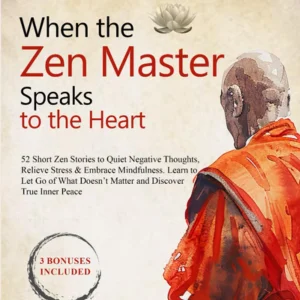
In an era of relentless notifications, digital clutter, and the constant pressure to “do more,” our internal landscapes often feel like a stormy sea. We are plagued by negative thought loops, “hustle culture” burnout, and a profound disconnection from the present moment.
Enter Tenzin Dolma Lhamo’s transformative work: When the Zen Master Speaks to the Heart: 52 Short Zen Stories to Quiet Negative Thoughts, Relieve Stress & Embrace Mindfulness.
This book isn’t just a collection of parables; it is a practical manual for the modern soul. Designed as part of the “Buddhism for Beginners” series, it distills ancient Eastern wisdom into 52 bite-sized stories—one for every week of the year—to help readers navigate the complexities of the human experience.
Why Zen Stories? The Power of the Parable
Before diving into the chapters, it is essential to understand why Zen uses stories. Logic often hits a wall when dealing with emotions like grief or anxiety. However, a story bypasses the analytical mind and speaks directly to the subconscious. Lhamo uses these metaphors to bridge the gap between “knowing” mindfulness and “living” it.
Chapter I: Self-Reflection and Awareness – The River of the Mind
The journey begins with the foundation of all spiritual growth: Awareness. If you don’t know where you are, you cannot find your way home.
Key Stories & Lessons:
- The River of the Mind: Lhamo compares our thoughts to a flowing river. The goal isn’t to stop the river, but to sit on the bank and watch it pass without jumping in.
- “When You Drink Tea, Just Drink Tea”: This is perhaps the most famous Zen teaching. It highlights the tragedy of “splitting” our attention. If you are drinking tea but thinking about taxes, you are not truly living.
- The Sound of Silence: We often fear silence because it forces us to confront ourselves. Lhamo teaches that silence is not the absence of sound, but the presence of peace.
- The Lantern and the Shadow: This story explores the duality of our nature. Light creates shadows; awareness helps us accept our “shadow self” rather than fighting it.
Chapter II: Self-Acceptance, Personal Growth, and Discipline
Transformation is a slow process. Chapter II shifts the focus from observing the mind to shaping the character through discipline and radical self-acceptance.
Key Stories & Lessons:
- The Temple Mirror: We often see a distorted version of ourselves. This story encourages us to wipe away the “dust” of societal expectations to see our true reflection.
- The Overflowing Cup: You cannot learn if you are already “full” of your own opinions. To grow, one must maintain “Shoshin”—a beginner’s mind.
- The Bamboo that Grows: Bamboo spends years growing roots underground before a single sprout appears. This is a metaphor for personal growth; just because you don’t see results today doesn’t mean you aren’t growing.
- If You Fall Seven Times, Stand Up Eight: A powerful lesson on resilience. In Zen, “failure” is merely another form of practice.
Chapter III: Negative Thoughts – Navigating the Storm
This chapter provides the “first aid kit” for mental health. Lhamo addresses the “thorns” that prick our peace.
Key Stories & Lessons:
- The Garden of Thoughts: Our mind is a plot of land. If we don’t actively plant flowers (positive intentions), weeds (negative thoughts) will grow automatically.
- The Bridge of Clouds: Thoughts are like clouds—they look solid and heavy, but you can walk right through them. They have no substance unless you give it to them.
- The Storm and the Lake: When a storm hits a lake, the surface is chaotic, but the depths remain still. Zen teaches us to live in the depths of our being, not on the surface of our emotions.
- Letting Go: This story features the classic metaphor of holding onto a hot coal. The only person getting burned is you. Dropping the coal is an act of self-mercy.
Chapter IV: Relationships and Love – The Web of Life
Zen isn’t just about sitting on a mountain; it’s about how we treat the person in front of us. This chapter explores the “loosened knot” of attachment versus the “flow” of love.
Key Stories & Lessons:
- The Basket of Fruit: Generosity isn’t about the gift; it’s about the spirit of giving without expecting a “thank you.”
- The Flower that Embraced the Sun: A lesson in non-possessive love. To love a flower, you don’t pluck it (which kills it); you water it and let it be.
- The Web of Life: Reminds us of Interbeing. Nothing exists in isolation. Our kindness to others is, quite literally, kindness to ourselves.
- The Loosened Knot: Conflict in relationships is often a knot we pull too tight. Lhamo suggests that sometimes, the best way to solve a problem is to relax your grip.
Chapter V: Reaching Inner Peace – The Stillness of the Heart
Inner peace is often misunderstood as an escape from reality. Lhamo argues that true peace is found within the chaos, not away from it.
Key Stories & Lessons:
- The Lotus in the Mud: The lotus is the ultimate Buddhist symbol. It grows in muck and grime but emerges unstained. This teaches us that our environment doesn’t have to define our purity.
- The Master’s Silence: Sometimes, the most profound answer to a complex question is a simple, peaceful presence.
- The Falling Leaf: Nature doesn’t resist the seasons. The leaf doesn’t fight the wind in autumn; it trusts the cycle. Peace comes from surrendering to the natural flow of life (Anicca).
- The Circle of Time: A reflection on the present moment. The past is a memory; the future is a dream. Only the “Now” is real.
Chapter VI: Intuition, Wisdom, and Enlightenment
The final chapter delves into the “Invisible Path”—the realization that enlightenment isn’t a destination, but a way of seeing.
Key Stories & Lessons:
- The Reflection of the Moon: You can see the moon reflected in a puddle, but the puddle is not the moon. Don’t mistake the “finger pointing at the moon” (the teachings) for the moon itself (the experience).
- The Closed Door: We often spend so much time banging on a closed door that we fail to notice the wall has already crumbled beside it.
- The Return to the Source: This is the “Zen Circle.” After the journey of seeking, you return to where you started, but you see the world with new eyes.
- The Garden and Impermanence: Everything changes. To find wisdom is to embrace impermanence (Anitya) without fear.
Related Articles


The Way Out Is In: A Journey to Mindfulness Through Zen Calligraphy
In the world of mindfulness, few figures have bridged the gap between ancient wisdom and modern living as gracefully as Thich Nhat Hanh. His book, Way Out Is In: The Zen Calligraphy of Thich Nhat Hanh, stands out as an embodiment of both art and spirit—a collection where words,

Final Reflections: The Core Message of Tenzin Dolma Lhamo
What is the author truly trying to convey? Through these 52 stories, Lhamo argues that suffering is optional. While pain, loss, and stress are inevitable parts of the human condition, the anguish we feel is often a result of our resistance to reality.
The Author’s Three Pillars:
- Simplicity: You don’t need a PhD in philosophy to be happy. You just need to “drink your tea.”
- Responsibility: Your mind is your own. You have the power to weed the garden or let the thorns take over.
- Compassion: Peace starts with being kind to yourself, which naturally overflows into kindness for the world.
“The sound of the bell does not stay in the bell, and it does not stay in the ear. It happens in the space between.” — This book aims to be that “space between” for the reader.
Conclusion: Is This Book for You?
If you are a “Buddhism Beginner” or someone simply looking for a way to lower your cortisol levels, When the Zen Master Speaks to the Heart is a gentle, poetic, and highly effective guide. It doesn’t demand that you change your religion; it only asks that you change your perspective.
By reading one story a week, you allow the lessons to marinate. You begin to see your “river of the mind” not as a threat, but as a beautiful, natural process. You learn to let go of the “clay jug” of the ego and embrace the “stillness of the heart.”
FAQs
Q1: Is this book suitable for someone who is a beginner in Buddhism?
A: Yes, absolutely! The book breaks down deep Zen wisdom into simple, conversational, and highly relatable parables. You do not need any prior background in Eastern philosophies to understand these lessons; it serves as a gentle introduction to mindfulness and inner peace for readers from all spiritual walks of life.
Q2: How do these Zen short stories help with daily stress relief?
A: Each short story acts as a quick mental reset that naturally lowers anxiety. By encouraging deep emotional awareness, present-moment mindfulness, and radical acceptance, these simple tales teach you how to calmly step away from overwhelming thoughts and establish lasting mental clarity amidst the chaos of everyday life.
Q3: Is the message of the Zen Master deeply religious or practical?
A: It is far more practical than religious. While rooted in ancient spiritual traditions, the core focus remains entirely on daily life applications. It avoids demanding dogmatic beliefs, choosing instead to guide you on managing a restless mind, letting go of painful attachments, and practicing everyday compassion.
Q4: Can reading this book help me overcome persistent negative thinking?
A: Yes, it is explicitly designed to address exactly that. Many chapters directly target negative thought loops and toxic overthinking. By shifting your mindset toward the nature of impermanence, the text provides you with powerful emotional tools to view your chaotic thoughts objectively and let them float away peacefully.
Q5: Who should read this book to get the most benefit?
A: This book is perfect for anyone currently feeling overwhelmed by daily life, battling chronic stress, or looking to build a consistent meditation practice. If you are seeking deep personal clarity, a peaceful heart, or a gentle introduction to practical mindfulness, this text will resonate with you completely.