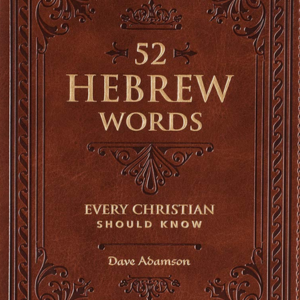
What can learning a few Hebrew words add to your Bible study? Dave Adamson’s 52 Hebrew Words Every Christian Should Know approaches that question through 52 Hebrew terms presented as a weekly devotional-style study. The book introduces readers to words connected with themes such as faith, mercy, peace, worship, wisdom and the character of God. It is designed for Christians who want an accessible introduction to Hebrew vocabulary and biblical culture without undertaking a formal Hebrew-language course.
In this review, we look at what the book contains, examine some of its key Hebrew words, discuss its strengths and limitations, and consider who may find it useful for Bible study.
52 Hebrew Words Every Christian Should Know — Quick Facts
Detail | Information |
Book | 52 Hebrew Words Every Christian Should Know |
Author | Dave Adamson |
Subject | Biblical Hebrew words and Christian devotional study |
Format | 52-word study / devotional reference |
Length | 120 pages |
Audience | Christians interested in Scripture and Hebrew vocabulary |
Difficulty | Beginner-friendly |
Purpose | Exploring Hebrew words, meanings and biblical context |
The book is listed as a 120-page volume, and current descriptions characterize it as an accessible reference/study guide to Hebrew words and their meanings.
Table of Contents
ToggleWhat Is 52 Hebrew Words Every Christian Should Know About?
52 Hebrew Words Every Christian Should Know by Dave Adamson serves as an accessible devotional guide designed to help believers engage more deeply with biblical scripture through the lens of ancient Hebrew thought. Rather than teaching formal Hebrew grammar, morphology, or syntax, the book introduces 52 foundational biblical Hebrew terms and explores their cultural, historical, and spiritual significance.
It is essential to clarify that this resource is not a systematic Hebrew language course. Instead, it functions as a visual devotional and topical reference guide. As framed by its publisher, Moody Publishers, the book bridges the gap between academic biblical scholarship and everyday spiritual life. It offers readers an enriching look at biblical terminology, historical context, and original nuance—without requiring prior training in biblical languages or academic lexicons.
Who Is Dave Adamson?
Understanding the author’s background clarifies the accessible, visually engaging tone of the book.
Dave Adamson is an Australian author, communicator, and digital ministry pioneer. Before transitioning into pastoral leadership, he worked as a professional television sports reporter and news cameraman in Australia. Later, he served as one of the world’s first full-time online pastors at North Point Ministries in Atlanta, Georgia.
Adamson blends his storytelling background, photographic eye, and passion for the historical lands of the Bible to communicate ancient biblical context in a contemporary digital format. His goal in writing about Hebrew words is pastoral and practical: to help modern Christians experience Scripture within its original cultural and linguistic world, making ancient truths relatable to daily faith.
Key Hebrew Words Discussed in the Book
A Note on Hebrew Meanings and Translation
Ancient Hebrew words do not possess a single fixed English equivalent or a secret “hidden” definition. Their true meaning varies depending on literary genre, sentence syntax, grammatical form, and historical context. The explanations below are simplified for general readers and should serve as an entry point for personal reflection rather than a replacement for academic lexicons or formal language study.
Rather than approaching biblical vocabulary as an overwhelming dictionary, grouping these terms thematically makes their cultural and narrative context much easier to grasp:
Words Related to God and His Character
- Elohim (אֱלֹהִים): The primary general Hebrew title for God throughout the Old Testament, emphasizing sovereignty, divine majesty, and creative power in texts like Genesis 1.
- Yahweh (יהוה): The sacred personal covenant name of God (the Tetragrammaton), revealed to Moses at the burning bush, pointing to God’s eternal, self-existent, and relational nature.
- Chesed (חֶסֶד): Often rendered as “lovingkindness,” “steadfast love,” or “mercy,” chesed expresses God’s faithful, covenant-keeping commitment and active grace toward His people.
- Emet (אֱמֶת): Translated as “truth” or “faithfulness,” representing enduring reliability, integrity, and stability rather than merely abstract factual accuracy.
- Kadosh (קָדוֹשׁ): Commonly translated as “holy,” highlighting God’s unique “set-apartness,” absolute purity, and distinct moral perfection.
Words Related to Faith and Spiritual Life
- Emunah (אֱמוּנָה): Frequently rendered as “faith” or “faithfulness.” In ancient Hebrew thought, emunah emphasizes steady, active trust and steadfast reliability rather than passive cognitive belief.
- Tikvah (תִּקְוָה): Translated as “hope,” carrying an etymological association with an expectant cord or waiting line—signifying patient, anchored anticipation in God.
- Ahavah (אַהֲבָה): The biblical concept of love, conveyed primarily through active, loyal commitment, covenant choice, and deliberate devotion.
- Yirah (יִרְאָה): Rendered as the “fear of the Lord,” encompassing reverent awe, deep honor, and holy respect rather than dread or terror.
- Shalom (שָׁלוֹם): Commonly translated as “peace.” While often understood simply as the absence of conflict, biblical usage frequently encompasses well-being, wholeness, safety, and sound health within community and covenant.
Words Related to Worship and Praise
- Hallelujah (הַלְלוּ יָהּ): A dynamic compound liturgical phrase combining halal (to boast, praise, or celebrate) and Yah (a shortened form of Yahweh), meaning “Praise the Lord!”
- Todah (תּוֹדָה): An offering of thanksgiving, praise, or gratitude, often accompanied by an intentional confession of what God has done.
- Yadah (יָדָה): A posture of thanksgiving and worship associated with extending the hands, offering public acknowledgement, and declaring God’s attributes.
- Zamar (זָמַר): To sing praise, especially to the accompaniment of musical strings or instrumentation.
- Kavod (כָּבוֹד): Translated as “glory,” fundamentally tied to the root concept of “weightiness,” importance, and visible divine presence.
Words Related to Human Life and Being
- Nephesh (נֶפֶשׁ): Often translated as “soul,” though Hebrew anthropology views the nephesh not as a disembodied ghost, but as a living, breathing being, an embodied appetite, or the whole person.
- Lev (לֵב): Translated as “heart,” functioning in ancient Hebrew thought as the center of intellect, volition, purpose, and decision-making—not solely emotion.
- Basar (בָּשָׂר): The physical “flesh” or body, emphasizing human frailty, creatureliness, and tangible physical existence.
- Ruach (רוּחַ): A versatile word that can mean “wind,” “breath,” or “spirit,” depending entirely on sentence context, highlighting invisible power and life-giving energy.
Hebrew Words vs. Biblical Context: At a Glance
The table below contrasts common English translations with the contextual concepts explored across Scripture:
Hebrew Term | Common English Rendering | What to Explore in Biblical Context |
Shalom | Peace | Explores communal well-being, wholeness, rest, and reconciliation rather than simply the absence of war. |
Chesed | Lovingkindness / Steadfast love | Highlights enduring covenant loyalty, unwavering relational commitment, and divine mercy. |
Shema | Hear / Listen | Refers to the pivotal command in Deuteronomy 6; combines hearing with active, obedient response. |
Ruach | Spirit / Wind / Breath | Signifies unseen power and life; meaning shifts between physical atmosphere, human vitality, and God’s Spirit. |
Nephesh | Soul / Life / Living being | Reflects biblical anthropology; represents a whole living creature or physical throat/appetite rather than a detached spirit. |
Teshuvah | Repentance / Return | Rooted in physical movement—turning around, reorienting one’s direction, and returning to God’s path. |
Emunah | Faith / Faithfulness | Emphasizes personal reliability, steadfast support, and ongoing endurance rather than mere mental assent. |
Related Articles

52 Hebrew Words Every Christian Should Know: Book Review
What the Book Does Well
- Accessible Entry Point: Adamson writes for everyday Christians rather than seminarians. The terminology is stripped of overly technical jargon, making ancient concepts easy to digest.
- Visual Presentation: Featuring full-color photography from Israel and the ancient Near East, the book’s visual design reinforces the physical and geographical setting of the biblical texts.
- Practical, Bite-Sized Format: Arranged neatly across 52 entries, the layout is ideal for a year-long weekly devotional, small group icebreaker, or personal morning study.
Where Readers Should Be Careful
While the book succeeds as a devotional aid, readers should maintain balanced hermeneutical expectations:
Devotional Reflections vs. Academic Lexicography: Devotional insights should not be confused with formal linguistic analysis. Hebrew words carry complex semantic ranges that cannot be captured in a single devotional entry.
The Danger of the “Root Fallacy”: Tracing the etymology or pictographic roots of a Hebrew word does not automatically determine how a biblical author used it in a specific historical text.
Context Governs Meaning: A word derives its specific definition from its immediate paragraph and grammatical setting, not from a single static definition.
Avoiding Theological Oversimplification: Hebrew is not inherently “more spiritual” than biblical Greek, and discovering a Hebrew cultural background rarely overturns clear doctrine or plain Bible translations.
Understanding the “Hebrew Mindset vs. Greek Mindset”
In 52 Hebrew Words Every Christian Should Know, Dave Adamson contrasts what he presents as Hebrew and Greek ways of reading the Bible. The text encourages readers to move past abstract Western analysis toward the tangible, relational, and action-oriented nature of ancient Hebrew thought.
Rather than treating this contrast as a strict linguistic fact, readers should understand it as the author’s devotional framework. Linguists and biblical scholars often caution against treating ancient cultures as monolithic thinking styles. Viewing this dynamic through a pastoral lens helps you appreciate the narrative and practical imagery of the Old Testament without oversimplifying how the ancients processed truth.
What Languages Did Jesus Actually Speak?
Popular Christian discussions often make sweeping statements about Jesus speaking exclusively Hebrew or thinking solely in Semitic thought patterns. However, historical and linguistic evidence paints a richer, more complex picture of first-century Judea and Galilee.
Jesus lived in a vibrant, multilingual society where people routinely interacted across cultural and commercial boundaries. Most historians agree that Aramaic served as his primary everyday spoken tongue. He would have known and read biblical Hebrew in liturgical and synagogue contexts, while likely using conversational Hellenistic Greek to communicate in broader trade settings. Framing Jesus within this dynamic environment honors historical reality far better than single-language assumptions.
Avoiding “Literal Meaning” Traps: Why Nuance Matters
A frequent pitfall in devotional literature is reducing a multi-layered ancient word to a single, sensational definition. Claims like “Avodah means work and worship are always identical” or “Simcha is purely a choice, never an emotion” flatten the dynamic flexibility of biblical Hebrew.
Hebrew words shift in emphasis depending on verbal stems, literary genre, and historical context. To maintain editorial integrity, verify popular claims with standard biblical lexicons like Brown-Driver-Briggs (BDB) or HALOT before teaching them.
Hebrew Term | Transliteration | Popular Devotional Claim | Lexical Reality & Context | Key Biblical Usage |
עֲבוֹדָה | Avodah | “Work and worship are always the exact same word.” | Means labor, service, or cultic work; the immediate sentence determines if the task is secular or priestly. | Exodus 1:14 (hard labor); Numbers 4:47 (tabernacle duty) |
שִׂמְחָה | Simcha | “Joy is purely a cognitive decision, never an emotional feeling.” | Encompasses spontaneous celebration, gladness, religious festive joy, and emotional merriment. | Psalm 100:2 (gladness); Ecclesiastes 2:2 (pleasure) |
חָוָה | Chavah | “Directly means to breathe life continuously.” | Primarily an archaic root meaning “to live” or “declare”; forms the etymological backdrop for Eve’s name (Chavvah). | Genesis 3:20 (mother of all living); Job 37:6 (archaic form) |
What the Book Can and Cannot Teach You
Setting healthy expectations ensures you get the most out of Adamson’s work without mistaking it for seminary-level research.
What It Can Do:
- Introduce foundational biblical Hebrew vocabulary in bite-sized portions.
- Encourage closer, more attentive reading of Old Testament narratives.
- Provide cultural background and geographical imagery that brings stories to life.
- Supply weekly spiritual reflections grounded in ancient Near Eastern context.
- Serve as an accessible springboard for more serious personal study.
What It Cannot Replace:
- Systematic grammar, morphology, or sentence syntax courses.
- Standard Hebrew lexicons (such as BDB, HALOT, or Holladay).
- Textual criticism and comparative ancient Semitic language studies.
- Verse-by-verse academic exegesis and peer-reviewed commentaries.
Is 52 Hebrew Words Every Christian Should Know Worth Reading?
Rather than assigning an arbitrary numerical score, the value of this book depends entirely on your study goals and background knowledge.
This book is a great fit if you:
- Are a beginner seeking an approachable starting point for biblical Hebrew.
- Prefer devotional reading over dense technical textbooks.
- Want an organized, 52-week study framework for personal reflection or small groups.
- Value high-resolution photography and visual connections to the lands of the Bible.
You may want a different resource if you:
- Already have formal training in biblical languages or basic Hebrew grammar.
- Seek exhaustive lexical entries that trace word frequencies across manuscripts.
- Need advanced, verse-by-verse exegesis for sermon preparation or academic papers.
Is There a Follow-Up to 52 Hebrew Words?
Dave Adamson expanded on this devotional model with a companion title: 52 Names of God in Hebrew Every Christian Should Know.
While the first volume surveys broad theological and cultural terms like Shalom, Chesed, and Ruach, the follow-up zeroes in on the divine titles used throughout the Old Testament. It retains the same accessible style, full-color photography, and weekly devotional rhythm to unpack titles like Yahweh Yireh, El Shaddai, and Yahweh Rapha for modern readers.
Frequently Asked Questions
Is 52 Hebrew Words Every Christian Should Know a Hebrew language course?
No, this book is not a formal Hebrew language course or grammar textbook. Instead, it serves as an accessible devotional and topical reference guide. Dave Adamson introduces 52 foundational biblical Hebrew terms to help believers understand their spiritual depth, cultural background, and historical context without getting bogged down in complex linguistic rules or academic syntax.
What language did Jesus speak in first-century Galilee?
Jesus lived in a vibrant, multilingual society across first-century Judea and Galilee. Historical and biblical evidence indicates he primarily spoke Aramaic in daily life, read and quoted Scripture in biblical Hebrew during synagogue worship, and likely used conversational Greek for trade and broader communication. He was not limited to a single spoken language.
Do biblical Hebrew words have single, hidden meanings?
No. Biblical Hebrew words rarely have one fixed English translation or secret “hidden” definition. Ancient Hebrew words possess broad semantic ranges, meaning their precise sense shifts based on literary context, grammar, and sentence structure. Devotional explanations offer great starting points, but they should never replace standard biblical lexicons or careful verse-by-verse study.
Who should read 52 Hebrew Words Every Christian Should Know?
This book is ideal for everyday Christians, small groups, and beginners who want an easy weekly study exploring Old Testament vocabulary and imagery. If you enjoy devotional reading paired with vivid photography of biblical lands, it is a great fit. However, students looking for rigorous grammatical instruction or academic exegesis will need standard language textbooks.
Is there a sequel or companion book to 52 Hebrew Words?
Yes, Dave Adamson authored a direct companion volume titled 52 Names of God in Hebrew Every Christian Should Know. While the original book explores broader thematic vocabulary like shalom, chesed, and ruach, the follow-up focuses entirely on divine titles such as Yahweh Yireh and El Shaddai using the same weekly devotional format.