
Don’t Give Up Faith-driven courage – Conquer Your Deepest Fears (2026)
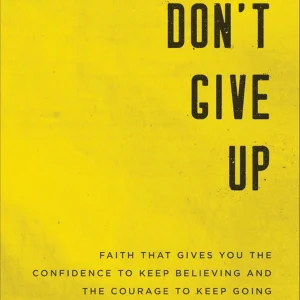
Life is rarely a straight line of triumphs. For most of us, it’s a series of grueling climbs, unexpected valleys, and moments where the finish line feels so distant it might as well be a mirage. If you’ve ever felt like throwing in the towel—whether in your marriage, your career, or your faith—Kyle Idleman’s Don’t Give Up is the manual for your weary soul.
In this comprehensive summary and review, we explore Idleman’s roadmap for finding the “second wind” necessary to finish the race.
The Core Message: Why We Give Up
Before diving into the chapters, it’s essential to understand Idleman’s premise. He suggests that “giving up” isn’t usually a sudden crash; it’s a slow leak. We lose our breath, we lose our focus, and eventually, we lose our will.
Idleman uses the metaphor of a marathon, heavily drawing from Hebrews 12:1-3. His message is clear: You were not meant to run this race alone, and you were not meant to run it burdened. —
Section 1: Listen to the Crowd
Many people think “the crowd” is a distraction. Idleman flips this on its head, referring to the “great cloud of witnesses”—those who have gone before us and are cheering us on.
Chapter 1: Keep Believing
Idleman starts by addressing the fatigue of the soul. When we face repeated setbacks, our belief system begins to erode. He argues that keeping your belief isn’t about ignoring reality; it’s about acknowledging a higher reality. The “crowd” in heaven consists of people like Abraham and Sarah, who waited decades for a promise. Their lives scream: It’s too soon to quit.
Chapter 2: Keep Fighting
Faith is often portrayed as passive, but Idleman describes it as a combat sport. To “keep fighting” means identifying the specific spiritual and emotional enemies that want to sideline you. The courage to keep going comes from knowing that the battle has already been won, even if the current skirmish feels overwhelming.
Chapter 3: Keep Perspective
Perspective is the difference between a stumbling block and a stepping stone. When we are in the thick of a trial, we have “tunnel vision”—we only see the pain. Idleman encourages readers to zoom out. By listening to the stories of those who survived similar trials, we regain the perspective that our current season is just that: a season.
Section 2: Throw Off the Weight
You can’t run a marathon in a winter coat while carrying suitcases. In this section, Idleman identifies the specific “weights” that slow us down.
Chapter 4: Unhindered by Anxiety
Anxiety is perhaps the heaviest weight of the 21st century. Idleman doesn’t offer platitudes; he offers a shift in focus. He explains that anxiety often stems from trying to control things that are not ours to carry. By “throwing off” the need for control, we find the lightness required to keep moving.
Chapter 5: Unchained from Religion
This is a classic Idleman theme (reminiscent of Not a Fan). He distinguishes between “religion”—a heavy list of rules and performance metrics—and “relationship.” Religion exhausts us because we can never do enough. Grace, however, provides the energy we lack. If your faith feels like a chore, you’re likely chained to religion rather than connected to Christ.
Related Articles


Chapter 6: Unleashed from Lies
We all have a soundtrack of lies playing in our heads: “You’re a failure,” “It will always be this way,” “No one cares.” These lies act as anchors. Idleman emphasizes the importance of replacing these lies with biblical truth. To be “unleashed” is to stop believing what the enemy says about you and start believing what the Creator says about you.
Chapter 7: Untangled from Unbelief
Unbelief is often more subtle than outright atheism. It’s the “functional atheism” where we say we believe in God but live as if everything depends on us. This “tangle” trips us up. Idleman provides practical ways to identify areas of lingering unbelief and how to surrender them to God.
Section 3: Run Your Race
Once the weights are gone, you still have to move your feet. This section is about the mechanics of perseverance.
Chapter 8: Obstacle Course
The Christian life isn’t a paved track; it’s an obstacle course. Idleman prepares the reader for the inevitability of hurdles. Expecting the obstacles makes them less daunting when they appear. He encourages us to view each obstacle as a “faith-muscle” builder.
Chapter 9: One Step at a Time
When you look at the 20 miles remaining, you quit. When you look at the next ten feet, you keep going. This chapter is a masterclass in the “theology of the next step.” Idleman argues that God rarely gives us the map for the whole journey; He just gives us enough light for the next step.
Chapter 10: Keep Your Confidence
Confidence, in the biblical sense, isn’t self-esteem—it’s “God-esteem.” It’s a firm persuasion that God is who He says He is. Idleman explains that when our confidence is rooted in our performance, it wavers. When it’s rooted in His promises, it becomes unshakable.
Epilogue: Can’t Stop. Won’t Stop.
The book concludes with a rallying cry. Idleman reminds us that the finish line is worth the agony of the race. He leaves the reader with the image of a God who doesn’t just watch us from the finish line but runs alongside us, whispering, “Don’t give up.”
Key Takeaways and Author’s Intent
What does Kyle Idleman really want you to walk away with?
- Normalization of Struggle: He wants to remove the shame of feeling weary. Even the strongest “heroes of faith” had moments of wanting to quit.
- The Power of Community: You cannot finish this race in isolation. You need the “crowd” (the cloud of witnesses) and your local “teammates.”
- Active Surrender: “Don’t give up” doesn’t mean “try harder.” It means “trust more.” It’s an active decision to stay in the race by relying on a power beyond your own.
Comparison Table: Religion vs. Faith (As described by Idleman)
Feature | Religion | Faith/Relationship |
Motivation | Fear and Guilt | Love and Gratitude |
Focus | My performance | Christ’s performance |
Energy Level | Exhausting | Sustaining |
Outcome | Burnout | Perseverance |
Final Review: Is It Worth the Read?
Kyle Idleman has a knack for being “convincingly relatable.” He uses humor and modern-day anecdotes to make ancient biblical truths feel fresh. Don’t Give Up is not a “pull yourself up by your bootstraps” kind of book. Instead, it’s a “lean on the One who carries you” kind of book.
If you are in a season of “the mucking middles”—that place where the excitement of the start has faded and the joy of the finish isn’t yet in sight—this book is your oxygen mask.
Frequently Asked Questions (FAQ)
Q1: How can I build faith-driven courage when life gets overwhelming?
A1: Building faith-driven courage starts by shifting your focus away from your fears and onto your spiritual foundation. When you lean into prayer, meditation, or scriptural promises, you naturally develop the inner strength needed to face life’s obstacles. Remember, true courage isn’t the absence of fear, but the deep-rooted trust that you are never walking through the storm alone.
Q2: What is the best way to throw off anxiety during a difficult time?
A2: To effectively throw off anxiety, you have to actively release the heavy burdens you’re carrying. Instead of letting stressful thoughts loop in your mind, try grounding yourself in the present moment through deep breathing or mindful gratitude. Entrusting your worries to a higher power allows you to trade your constant inner turmoil for a lasting, peaceful reassurance.
Q3: How do I find the strength to not give up on my personal goals?
A3: When you feel ready to quit, remember that perseverance is a muscle built through daily choices. You can find the strength to not give up by breaking your journey into smaller, manageable steps and celebrating tiny victories. Remind yourself of your original “why,” and trust that every single challenge you face is secretly shaping your character for future success.
Q4: What does it truly mean to run your race with endurance?
A4: To run your race with endurance means staying committed to your unique life path without constantly comparing your timeline to others. It is all about maintaining a steady, consistent pace, keeping your eyes fixed on the ultimate prize, and refusing to let temporary setbacks completely derail your momentum. Your journey is a marathon, not a quick sprint.
Q5: Can spiritual faith help me overcome a season of deep burnout?
A5: Yes, leaning into your spiritual faith provides a profound source of renewal when your mind and body are completely exhausted. By taking intentional time for spiritual rest and self-care, you invite divine strength to refill your empty cup. Faith reminds us that our worth isn’t tied to constant hustle, giving us permission to heal and recover.