
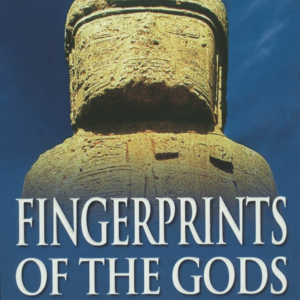
For decades, the standard narrative of human history has taught us that civilization began roughly 5,000 to 6,000 years ago in Sumer and Egypt. But what if everything we know is wrong? What if a sophisticated, global civilization existed thousands of years before the "cradle of civilization"?In his seminal work, Fingerprints of the Gods, Graham Hancock takes readers on a breathtaking journey across the globe—from the icy wastes of Antarctica to the peaks of the Andes and the Great Pyramids of Giza. This book is not just a summary of archaeological finds; it is a profound detective story that challenges the very foundations of history.
About the Author
Graham Hancock is not your typical historian. He’s more like a detective of ancient mysteries—someone who looks at history and asks, “What if we’ve got it all wrong?” In Fingerprints of the Gods, he challenges conventional archaeology and proposes that an advanced civilization existed long before what we consider the beginning of history.Hancock isn’t afraid to question authority, and that’s exactly what makes this book both controversial and fascinating. Instead of blindly accepting established timelines, he digs into myths, ancient maps, and unexplained monuments to paint a radically different picture of human history.
Core Thesis of the Book
At its heart, this book argues one bold idea:
Human civilization may be far older—and far more advanced—than mainstream history admits.Hancock suggests that a highly sophisticated civilization existed during the last Ice Age but was wiped out by a global catastrophe. The survivors, he claims, passed on their knowledge to ancient cultures like the Egyptians, Mayans, and Incas.Think of it like this: what if our history books are just the last chapter of a much longer story?
Part I — Introduction: The Mystery of the Maps
Ancient Maps and Hidden Knowledge
The book opens with a mind-blowing concept—ancient maps that seem impossibly accurate. Hancock discusses maps like the Piri Reis map, which appears to show Antarctica without ice. That’s strange because Antarctica has been covered in ice for thousands of years.So how did ancient cartographers know what lay beneath the ice?Hancock suggests that these maps were copied from even older sources—possibly created by an advanced civilization with knowledge of geography far beyond what we assumed was possible at the time.
Evidence of Lost Civilizations
In Chapters 2 and 3, Hancock builds on this mystery by examining river systems in Antarctica and the precision of ancient mapping techniques. He argues that such accuracy implies advanced surveying skills—skills that shouldn’t have existed thousands of years ago.It’s like finding a smartphone in a medieval castle. Something doesn’t add up.He calls these clues the “fingerprints” of a lost civilization—traces left behind by people whose existence has been erased from official history.
Part II — Foam of the Sea
Inca Civilization and Viracocha Myth
As Hancock moves into South America, he introduces us to the Inca legends of Viracocha—a mysterious god-like figure who arrived after a great catastrophe.According to the myths, Viracocha:
- Brought knowledge of agriculture and architecture
- Taught civilization to primitive people
- Disappeared across the ocean
Hancock believes Viracocha wasn’t a god—but a survivor of a lost civilization.
Giants, Gods, and Ancient Teachers
The chapters explore stories of giants, advanced beings, and sudden leaps in human knowledge. One recurring theme is this: civilization didn’t evolve slowly—it appeared suddenly.
Sites like Tiahuanaco near Lake Titicaca challenge conventional timelines. The precision of stonework and astronomical alignment suggests knowledge far beyond what the Incas supposedly possessed.Hancock proposes that these sites were built by earlier, more advanced people—and later inherited by known civilizations.
Part III — Plumed Serpent
Mesoamerican Civilizations and Mysteries
Moving into Central America, Hancock explores the legends of Quetzalcoatl, the “Plumed Serpent.” Just like Viracocha, this figure:
- Came from the east
- Brought knowledgePromised to return
- Different cultures, same story.
Coincidence? Hancock doesn’t think so.He argues that these recurring myths point to a shared origin—a lost civilization whose survivors traveled across the globe.
The Olmec Enigma and Time Calculations
The Olmecs are especially puzzling. Their massive stone heads and sudden cultural sophistication seem to appear out of nowhere.Hancock also examines the Mayan calendar, which demonstrates astonishing mathematical precision. Some interpretations even suggest knowledge of long cosmic cycles and catastrophic resets.It’s as if these civilizations weren’t discovering knowledge—they were remembering it.
Part IV — The Mystery of the Myths
Global Flood Myths and Catastrophe Theory
One of Hancock’s strongest arguments lies in global flood myths. Nearly every ancient culture—from Mesopotamia to India—has a story about a great flood that destroyed civilization.Is that just storytelling… or collective memory?Hancock suggests that these myths are fragmented memories of a real event—a massive global catastrophe at the end of the last Ice Age.
Ice Age Destruction Hypothesis
Around 12,000 years ago, Earth experienced dramatic climate changes. Hancock links this to:
- Rising sea levels
- Sudden extinctions
- Massive geological upheaval
He proposes that an advanced civilization existing during this time was wiped out almost overnight.
Imagine building a city—and then watching it disappear beneath rising oceans. That’s the scale of destruction he’s describing.
Part V — Cosmic Codes and Hidden Knowledge
Astronomy and Sacred Geometry
Hancock dives into ancient astronomy, showing how many monuments align with stars and constellations.For example:The pyramids of Giza align with Orion’s BeltAncient temples mirror celestial patternsThis suggests that ancient builders had advanced knowledge of the cosmos.
Osiris Numbers and Ancient Knowledge Systems
He introduces the concept of “Osiris numbers”—mathematical constants embedded in ancient structures.These numbers hint at:Advanced measurement systemsUnderstanding of Earth’s dimensionsKnowledge of astronomical cyclesIt’s like ancient architecture was a coded message—waiting for us to decode it.
Part VI — The Giza Invitation
Pyramids and Sphinx Mysteries
Hancock turns to Egypt, focusing on the pyramids and the Sphinx. He questions the traditional timeline, suggesting these structures may be much older than believed.The Sphinx, in particular, shows signs of water erosion—implying it was built during a wetter climate, possibly thousands of years earlier than accepted.
Hidden Messages in Architecture
The layout of Giza, Hancock argues, isn’t random. It’s a deliberate design—possibly encoding astronomical knowledge.Think of it as a giant, stone-built puzzle.
Part VII — Lord of Eternity
Egypt’s Advanced Knowledge
Hancock explores Egyptian texts and symbols, suggesting they inherited knowledge from earlier civilizations.He highlights:Advanced engineeringAstronomical alignmentMathematical precisionThese aren’t signs of a primitive society—they’re signs of inherited wisdom.
The Eleventh Millennium BC Theory
This is where Hancock drops one of his boldest claims:
The origins of civilization may date back to around 11,000 BC.
That’s far earlier than mainstream history suggests.
Part VIII — ConclusionThe Final Argument
Hancock concludes that:
- A lost civilization existed
- It was destroyed by a global catastrophe
- Its survivors spread knowledge worldwide
These survivors became the “gods” of ancient myths.
Author’s Message and Interpretation
The message is clear:
We don’t know our true history—and it’s time to question what we’ve been taught.
Critical Review
This book is fascinating, provocative, and deeply controversial. On one hand, Hancock presents compelling connections between myths, monuments, and unexplained anomalies. His storytelling is engaging—you’ll feel like you’re uncovering a hidden truth.But there’s a catch.Many archaeologists criticize the book for:Lack of concrete evidenceOverreliance on speculationSelective interpretation of dataSo where does that leave us?Think of this book not as a final answer—but as a powerful question. It challenges you to think differently, to explore, and to remain curious.
Conclusion
Fingerprints of the Gods isn’t just a book—it’s an intellectual adventure. It shakes the foundations of accepted history and invites you to explore a world where ancient civilizations were far more advanced than we imagined.Whether you agree with Hancock or not, one thing is certain:
You’ll never look at history the same way again.
FAQs
Q1. Is Fingerprints of the Gods based on real evidence?
Yes, but it combines real data with speculative interpretations, which is why it’s controversial.
Q2. What is the main idea of the book?
That an advanced civilization existed before recorded history and was destroyed by a catastrophe.
Q3. Is the book scientifically accepted?
No, mainstream archaeology does not accept Hancock’s theories.
Q4. Why is the book so popular?
Because it challenges established history and offers a thrilling alternative narrative.
Q5. Should I read it?
Absolutely—especially if you enjoy mysteries, ancient history, and unconventional ideas.