Table of Contents
ToggleNothing Special — Practical Zen Guidance for Finding Peace and Joy
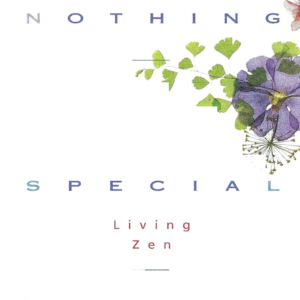
In a world saturated with self-help guides promising transformation through discipline, goal-setting, and relentless striving, Nothing Special by Charlotte J. Beck and Steve Smith arrives like a quiet breath of fresh air—subtle, profound, and deeply liberating. First published in 1993, this enduring spiritual classic remains startlingly relevant in our hyper-optimized, achievement-driven age. Far from offering a 10-step program to enlightenment, Nothing Special dismantles the very framework of spiritual ambition. Its core thesis is disarmingly simple—and radically counterintuitive: There is nothing special to attain. No peak experience to chase. No enlightened self to become.
Co-authored by Zen teacher Charlotte J. Beck—renowned for her down-to-earth, accessible teaching style rooted in the lineage of Maezumi Roshi—and her longtime student Steve Smith, the book is not a systematic treatise but a series of evocative, conversational essays drawn from Beck’s talks and dialogues. Structured into eight thematic sections—Struggle, Sacrifice, Separation and Connection, Change, Awareness, Freedom, Wonder, and Nothing Special—the book unfolds like a spiral staircase: each turn revisits familiar terrain from a slightly higher vantage point, inviting deeper insight without dogma or prescription.
Below, we offer a comprehensive, SEO-optimized, and deeply human-friendly review and summary—exploring each of the eight sections in detail, unpacking the authors’ central message, and reflecting on why this book continues to resonate so powerfully decades after its first appearance.
Struggle: The Illusion of the “Problem” to Be Solved
Beck begins where most of us live: in the thick of struggle. We struggle with anxiety, relationships, career setbacks, health issues, existential dread—the list is endless. Society reinforces this: “Fight your fears!” “Push through the pain!” “No pain, no gain!” Even spiritual paths often frame practice as a battle—against ego, desire, distraction.
But Beck challenges this directly:
“The struggle itself is the problem—not the situation you’re struggling with.”
She doesn’t deny real suffering (illness, loss, injustice). Rather, she points to how we relate to difficulty—our resistance, our narrative of “This shouldn’t be happening,” our frantic attempts to fix, control, or escape. This resistance is the second arrow, as the Buddha taught: the first arrow is pain; the second is our suffering about the pain.
In Struggle, Beck invites us to stop fighting—and instead, lean in. Not to passively endure, but to meet our experience with unflinching honesty: What is actually here? The tightness in the chest. The racing thoughts. The grief lodged in the throat. When we stop labeling it “bad” or “wrong,” the energy of resistance softens. What remains is simply life—raw, tender, and unmediated.
💡 Key Insight: Struggle isn’t eliminated by winning a battle—it dissolves in the willingness to stop fighting.
Sacrifice: Letting Go of the Heroic Self
We’re culturally conditioned to valorize sacrifice: the martyr parent, the burnt-out activist, the ascetic monk. We believe that giving up pleasure, comfort, or personal desire must mean something—it proves our worth, earns future reward, or purifies the soul.
Beck cuts through this spiritual consumerism:
“Real sacrifice isn’t about giving something up—it’s about giving up the idea that you need to give something up.”
She distinguishes between conditional sacrifice (I’ll suffer now for happiness later) and unconditional surrender—the dropping of the agenda altogether. True sacrifice isn’t dramatic or noble; it’s ordinary. It’s choosing to listen fully to a friend instead of rehearsing your reply. It’s allowing anger to arise without acting on it—or suppressing it. It’s saying “I don’t know” when you’re expected to have answers.
This section dismantles the “spiritual ego”—the part of us that wants to be seen as trying hard, being good, making progress. Beck gently suggests: What if enlightenment isn’t earned by heroic effort—but revealed when the hero finally sits down and stops performing?
💡 Key Insight: The greatest sacrifice is relinquishing the need to be special—even spiritually.
Separation and Connection: The End of the “Me” Project
Here, Beck enters the heart of nondual teaching—not as abstract philosophy, but as lived intimacy. We suffer because we believe in separation: me vs. you, inside vs. outside, self vs. world. Everything we do—seeking love, building careers, accumulating knowledge—is an attempt to bridge this perceived gap.
But Beck points out:
“You are not a separate self trying to connect. You are connection itself—temporarily believing in isolation.”
This isn’t poetic metaphor. Neuroscientifically, we are ecosystems—trillions of cells, bacteria, thoughts, sensations, in constant exchange with environment. Relationally, we are shaped by every interaction. Spiritually, we arise interdependently, like waves on a single ocean.
The section explores how moments of true connection—holding a crying child, laughing uncontrollably with a friend, watching a sunset—occur precisely when the “me” narrative momentarily drops out. No one is doing connection; it happens when the barrier dissifies.
Beck doesn’t advocate dissolving boundaries recklessly (healthy differentiation is vital). Instead, she invites a shift in perception: What if the boundary isn’t a wall—but a membrane, porous and responsive?
💡 Key Insight: Connection isn’t something we create—it’s what remains when separation is seen through.
Change: The Only Constant Is Flow
We fear change. We cling to stability, routine, identity. Yet as Heraclitus noted millennia ago, “No man ever steps in the same river twice.” Even our bodies replace most cells every 7–10 years. Thoughts, emotions, relationships—all in flux.
Beck doesn’t ask us to accept change (which implies a reluctant tolerance). She invites participation:
“Don’t be a leaf fighting the current. Be the river.”
In Change, Beck explores impermanence not as loss, but as aliveness. Grief, for instance, isn’t a problem to fix—it’s love continuing in absence. Aging isn’t decline—it’s deepening. Failure isn’t defeat—it’s data. When we stop labeling change as “good” or “bad,” we stop resisting reality—and enter a fluid responsiveness.
This section includes powerful reflections on death—not as endpoint, but as the ultimate teacher of non-attachment. As Beck puts it:
“If you’re afraid of dying, you’re not living. If you’re living fully, death is just the next breath.”
💡 Key Insight: Resistance to change is suffering. Alignment with flow is peace.
Awareness: The Space in Which Everything Arises
Many spiritual seekers chase altered states—bliss, oneness, visions. Beck redirects attention to the ever-present ground: ordinary awareness. Not the content of experience (thoughts, feelings), but the awareness in which they appear.
“You’re not the wave. You’re the ocean noticing the wave.”
This isn’t passive blankness. It’s vibrant, intelligent presence—like sunlight that doesn’t judge clouds but allows them to pass. Beck emphasizes embodied awareness: feeling your feet on the floor, the weight of your arms, the rhythm of breath—not as mindfulness technique, but as direct intimacy with being.
Critically, she warns against spiritualizing awareness:
“Awareness isn’t special. It’s what’s left when you stop adding specialness.”
The section includes practical pointers—not methods, but invitations:
- When upset, pause and feel bodily sensations before interpreting them.
- Notice the gap between stimulus and reaction—that’s freedom’s doorway.
- Listen to silence between words in a conversation.
💡 Key Insight: Awareness isn’t attained—it’s remembered. And it’s always here, beneath the noise.
Freedom: Not Freedom From, But Freedom To
Society equates freedom with options: more money, time, choices. Spiritually, we imagine freedom as liberation from suffering, desire, or ego.
Beck redefines it radically:
“Freedom isn’t getting what you want. It’s wanting nothing—not out of resignation, but out of fullness.”
True freedom is the ability to be exactly as you are, in exactly this situation—without needing it to be different. It’s not indifference; it’s unobstructed responsiveness. A parent caring for a sick child isn’t “free” in the conventional sense—yet in their total presence, there is profound freedom.
This section dismantles the myth of the “free individual.” Beck suggests: You’re never not interdependent. Freedom arises not in isolation, but in responsible engagement—answering the call of the moment without inner conflict.
💡 Key Insight: Freedom is not the absence of constraint—it’s the absence of resistance to what is.
Wonder: The Ordinary Made Extraordinary
In our rush to optimize, we overlook the miracle of the mundane: steam rising from coffee, a stranger’s smile, the hum of the refrigerator. Wonder isn’t reserved for mountaintops or cathedrals—it’s available in laundry-folding, traffic jams, dishwashing.
Beck writes:
“Wonder isn’t something you find. It’s what’s revealed when you stop looking for something else.”
This section is perhaps the most poetic—yet utterly practical. It invites childlike curiosity without childishness:
- Watch how light shifts across a wall for five minutes.
- Taste a raisin as if you’ve never eaten before.
- Notice how your body breathes itself, without your command.
Wonder, for Beck, is the natural state when the mind’s commentary (“This is boring,” “I’ve seen this before”) falls away. It’s not ecstatic—it’s quiet, steady, and grounding.
💡 Key Insight: Wonder isn’t rare—it’s our default setting, obscured by constant doing.
Nothing Special: The Culmination
The final section delivers the book’s title—and its deepest teaching. After exploring struggle, sacrifice, connection, change, awareness, freedom, and wonder, Beck circles back:
“All of this—every insight, every moment of clarity—is nothing special.”
Why? Because “special” implies separation: This experience is elevated; that one is mundane. It feeds the spiritual resume: I had a breakthrough. I felt oneness. I’m evolving.
But true realization is anti-climactic. It’s not a fireworks display—it’s noticing the dishes need washing, and washing them. It’s hearing criticism without defensiveness. It’s laughing at your own seriousness.
Nothing Special doesn’t mean nihilism or apathy. It means:
- No hierarchy of experiences (bliss ≠ better than boredom).
- No spiritual status (beginner ≠ less than master).
- No destination (enlightenment isn’t a finish line).
As Beck so memorably puts it:
“You’re already what you’re seeking. Not after twenty years of practice. Not when you finally ‘get it.’ Right now. As you read this sentence. You’re it—ordinary, imperfect, and complete.”
💡 Key Insight: The search ends when you realize you’ve never been lost.
The Core Message: Radical Inclusion
What, ultimately, do Charlotte J. Beck and Steve Smith want to convey?
Life is not a problem to be solved, but a reality to be lived—fully, messily, and without conditions.
The authors aren’t dismissing suffering or advocating passive resignation. Instead, they offer a third way beyond struggle and suppression: radical inclusion.
Include the anxiety. Include the doubt. Include the joy. Include the traffic jam. Include the grief. Include the hope.
Stop editing your experience to fit an ideal. Stop spiritual bypassing (“I shouldn’t feel angry”). Stop self-improvement as self-rejection.
Nothing Special is a call to inhabit your life—not the life you think you should have, but the one you actually do. It’s an invitation to stop waiting for a better version of yourself—and meet the one breathing, feeling, stumbling, loving, right here.
This isn’t easy. It’s not flashy. It won’t make you famous.
And that’s precisely the point.
Why Nothing Special Endures (And Why You Should Read It)
In 2025, as AI tutors promise personalized enlightenment and biohackers optimize every minute of consciousness, Nothing Special feels more urgent than ever. It’s an antidote to:
- Spiritual consumerism (buy this course, attend this retreat, achieve this state)
- Performance anxiety (Am I meditating right? Am I enough yet?)
- The tyranny of positivity (toxic insistence on “good vibes only”)
Beck’s voice—warm, witty, no-nonsense—makes profound truths accessible. You won’t find Sanskrit terms or complex rituals here. You’ll find stories about burnt toast, crying babies, and office politics—all gateways to awakening.
This book isn’t for those seeking quick fixes. It’s for those tired of seeking. For those ready to stop trying to be special—and discover the extraordinary in the utterly ordinary.
Final Thoughts: A Book That Reads You Back to Yourself
Nothing Special doesn’t give answers. It dissolves the questions.
Each time you return to it—perhaps after a breakup, a career shift, or a quiet morning—it meets you exactly where you are. Not to fix you, but to remind you:
You’re not broken. You’re not behind. You’re not lacking. You’re here. And that’s enough.
In a world shouting “More! Better! Faster!” Charlotte J. Beck whispers, with unshakable kindness:
“Just this. Just now. Just you—nothing special. And everything.”
FAQs
Q1. Is “Nothing Special” suitable for beginners in Zen?
Yes, the writing is simple, clear, and perfect for those new to Zen practice.
Q2. Is the book more philosophical or practical?
It’s both—philosophical ideas explained in a highly practical, everyday style.
Q3. What is the main message of the book?
That enlightenment lies in the ordinary, and awareness makes life extraordinary.
Q4. Do I need meditation experience to understand the book?
Not at all—the authors explain everything in a friendly, accessible tone.
Q5. Why should I read this book?
Because it helps you slow down, breathe, reconnect with life, and find peace in the present moment.