Table of Contents
ToggleNew Year New You: Transform Your Life in 2026
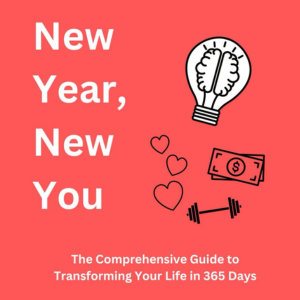
The turn of a calendar page often brings a surge of motivation, but as many of us know, that “New Year energy” often fizzles out by mid-February. In her groundbreaking book, “New Year New You: The Comprehensive Guide to Transforming Your Life in 365 Days,” author Aria Aria Wyndham provides more than just a motivational pep talk. She offers a rigorous, heart-centered, and practical framework for sustainable change.
This isn’t about temporary fixes; it’s about a total identity shift. In this detailed summary and review, we will break down all 12 chapters, exploring how Wyndham guides readers from the depths of reflection to the heights of living their best year ever.
Chapter 1: The Power of Reflection
Aria Aria Wyndham begins the journey not by looking forward, but by looking back. She argues that you cannot map a route to a new destination if you don’t truly understand where you are currently standing.
Reflection, in this context, is not about rumination or self-criticism. Instead, Wyndham introduces the “Mirror Principle,” a method of objective observation. She encourages readers to audit the past 12 months across various life pillars: health, relationships, career, and spirituality.
Key Takeaways:
- The “Why” Behind the “What”: Identifying not just what went wrong, but the underlying patterns that led to those outcomes.
- Honoring Wins: We often overlook our successes. Wyndham insists that acknowledging progress is the fuel for future change.
- Closing the Loops: Forgiving yourself for unfinished goals to clear mental space for the new year.
Chapter 2: Clarify Your Vision
Once the past is settled, Chapter 2 pivots to the future. Wyndham distinguishes between a “wish” and a “vision.” A wish is passive; a vision is a magnetic north.
The author challenges the reader to look beyond societal expectations. Are you chasing a promotion because you want it, or because you think you should want it? This chapter is dedicated to uncovering your Authentic Desire.
Exercises mentioned:
- The “Perfect Day” Scripting: Writing a detailed narrative of your ideal life in the present tense.
- The Values Alignment Test: Ensuring your vision aligns with your core values (e.g., freedom, security, creativity).
Chapter 3: Setting Authentic Goals
In one of the most practical sections of the book, Wyndham deconstructs traditional goal-setting. While she acknowledges the utility of SMART goals (Specific, Measurable, Achievable, Relevant, Time-bound), she introduces the concept of “Heart-Centered Objectives.”
An authentic goal is one that feels expansive rather than restrictive. If a goal feels like a “chore” before you even start, Wyndham suggests it isn’t aligned with your true self. She teaches readers how to bridge the gap between where they are and where their vision is through incremental, actionable steps.
Related Articles


Chapter 4: Harnessing the Law of Attraction
Wyndham ventures into the metaphysical in Chapter 4, explaining that our internal state dictates our external reality. She demystifies the Law of Attraction, stripping away the “magic” and replacing it with the concept of Vibrational Alignment.
The core idea is simple: You do not attract what you want; you attract who you are. By focusing on the feelings of gratitude and abundance now, you become a magnet for opportunities that match that frequency.
Wyndham’s 3-Step Process:
- Ask: Clearly state your intention.
- Believe: Remove the “how” from your mind and trust the process.
- Receive: Actively look for “breadcrumbs” or signs that lead you toward your goal.
Chapter 5: The Magic of Visualization
Building on the Law of Attraction, Chapter 5 discusses the neuroscience of visualization. Wyndham explains that the brain often cannot distinguish between a vividly imagined event and a real one.
By practicing Mental Rehearsal, you prime your subconscious mind to recognize opportunities and overcome fears. This chapter provides specific techniques, such as “Future-Self Meditation,” where you “interview” the version of yourself who has already achieved your goals.
Chapter 6: Cultivating a Positive Mindset
Transformation is impossible with a “fixed” mindset. Wyndham spends this chapter addressing the Inner Critic. She posits that positivity isn’t about ignoring the bad; it’s about choosing a narrative that empowers you.
She introduces the “Reframe Technique,” where every “I have to” is replaced with “I get to.” This shift in perspective transforms obligations into opportunities, drastically reducing stress and increasing resilience.
Chapter 7: Designing Supportive Habits
If the vision is the destination, habits are the vehicle. Aria Aria Wyndham leans on behavioral science to explain how to design a lifestyle that supports your goals automatically.
She introduces “Habit Architecture,” which includes:
- Habit Stacking: Attaching a new habit to an existing one (e.g., practicing gratitude while brushing your teeth).
- Environment Design: Making good habits easy and bad habits difficult (e.g., putting your workout clothes out the night before).
- The 2-Minute Rule: Starting any new habit with a version that takes less than two minutes to complete.
Chapter 8: Crafting a Personalized Self-Care Plan
In a world that glorifies burnout, Wyndham’s approach to self-care is refreshing and radical. She argues that self-care is not a luxury; it is a foundational requirement for transformation.
However, she moves beyond the cliché of bubble baths. Her “Personalized Self-Care Plan” focuses on:
- Emotional Hygiene: Processing feelings instead of suppressing them.
- Physical Vitality: Nutrition and movement as a form of self-respect.
- Intellectual Growth: Curating the information you consume to feed your mind.
Chapter 9: Navigating Obstacles and Setbacks
One of the most realistic chapters in the book, Chapter 9 acknowledges that the path to a “New You” is rarely a straight line. Wyndham provides a toolkit for the “Mid-Year Slump.”
She introduces the “Pivot Protocol,” teaching readers how to distinguish between a temporary hurdle and a sign that their path needs adjustment. The message here is clear: A setback is a data point, not a destination.
Chapter 10: Staying Accountable and Celebrating Progress
Transformation is a marathon, not a sprint. To stay the course, Wyndham emphasizes the need for systems of accountability. Whether it’s an “Accountability Buddy,” a coach, or a public declaration, having someone to answer to increases your success rate exponentially.
Crucially, she highlights the Power of Celebration. Small wins release dopamine, which rewires the brain to want to repeat the behavior. If you don’t celebrate the $10 saved or the one mile run, you lose the momentum needed for the larger milestones.
Chapter 11: Surrounding Yourself with Inspiration
Wyndham explores the concept of “Social Contagion.” You are the average of the five people you spend the most time with—but also the books you read, the podcasts you hear, and the social media feeds you scroll.
This chapter encourages a “Circle Audit.” Readers are asked to identify the “drainers” and the “radiators” in their lives. Wyndham advises curating an environment—both physical and digital—that serves as a constant reminder of who you are becoming, not who you used to be.
Chapter 12: Living Your Best Year Ever
The final chapter is a call to action. Wyndham integrates all the previous lessons into a cohesive lifestyle. “Living your best year ever” isn’t about achieving perfection; it’s about Living in Alignment.
She concludes by reminding the reader that 365 days is a long time if used intentionally. By the end of the book, the “New You” isn’t a future goal—it is a present reality built on the foundation of the 11 preceding chapters.
The Core Message: What Does Aria Aria Wyndham Want to Convey?
At its heart, “New Year New You” is a manifesto on Radical Self-Responsibility.
The author’s primary message is that you are the architect of your reality. Wyndham wants to convey that transformation is not something that happens to you; it is something you consciously engineer. She blends the “woo-woo” aspects of manifestation with the “hard” aspects of habit science to show that a balanced life requires both a dream and a discipline.
The book emphasizes that:
- Change is Incremental: You don’t need a quantum leap; you need 365 days of 1% improvements.
- Authenticity is Mandatory: You cannot sustain a version of yourself that is built for someone else’s approval.
- Resilience is a Skill: Being a “New You” means learning how to handle the “Old Problems” with a new perspective.
Final Review: Why This Book is a Must-Read in 2026
In an era of instant gratification, Aria Aria Wyndham’s book stands out because it respects the process. It doesn’t promise a new life in 30 days; it promises a new life through a year of intentionality. The writing is empathetic yet firm, acting as a supportive mentor who refuses to let you settle for less than your potential.
The structure of the book makes it a perfect reference guide. You can return to Chapter 9 when you’re struggling or Chapter 1 when you need a reset.
If you are tired of the cycle of “Start-Stop-Regret,” this comprehensive guide is the manual you’ve been waiting for. It is time to stop waiting for a lucky break and start building the life you were meant to live.
How to Get Started Today
- Step 1: Conduct your Mirror Audit (Chapter 1).
- Step 2: Define your “North Star” Vision (Chapter 2).
- Step 3: Commit to the next 365 days with unwavering intention.
Frequently Asked Questions
Q1: Is this life transformation guide only useful at the start of the New Year?
A: Not at all! While inspired by New Year resolutions, this 365-day life transformation guide works whenever you are ready for a fresh start. You can launch your personal growth journey on any date—whether it is January 1st, mid-summer, or today.
Q2: How does this 365-day guide balance mindset shifts with practical action?
A: The guide seamlessly combines mindset work with actionable daily steps. Author Aria Wyndham pairs manifestation, visualization, and positive reframing with habit architecture, goal setting, and accountability systems. This ensures you do not just dream about personal growth, but actively engineer real, sustainable life changes.
Q3: Can beginners in personal development easily follow these growth techniques?
A: Absolutely. The concepts are broken down into simple, incremental steps that anyone can apply. From basic reflection exercises to habit stacking, the framework avoids complex jargon. It offers clear guidance designed to make personal transformation manageable for beginners and experienced readers alike.
Q4: What makes this personal growth book different from other self-help guides?
A: Unlike quick-fix self-help books that promise instant results, this framework focuses on a sustainable, 365-day identity shift. It bridges metaphysical concepts like the Law of Attraction with behavioral science and habit design, offering a grounded, realistic roadmap for long-term personal growth.
Q5: What exercises are included to help me set authentic goals and track progress?
A: The guide includes practical tools like “Perfect Day” scripting, values alignment tests, and habit stacking techniques. You will also learn the Mirror Principle for objective self-reflection and the Pivot Protocol to navigate setbacks smoothly while tracking and celebrating your daily progress toward your goals.