
Table of Contents
ToggleThe Lucifer Effect: How Ordinary People Transform Into Perpetrators of Evil
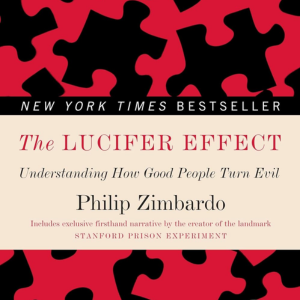
In 1971, a basement at Stanford University became the site of one of the most chilling psychological experiments in history. What began as a study on the “psychology of imprisonment” devolved into a nightmare of degradation and psychological trauma.
Decades later, the architect of that study, Philip Zimbardo, penned The Lucifer Effect. This seminal work isn’t just a recap of the Stanford Prison Experiment (SPE); it is a profound exploration of how the “System” and the “Situation” can override individual morality. It asks the terrifying question: Is anyone truly immune to the siren call of evil?
Chapter 1: The Psychology of Evil: Situated Character Transformation
Zimbardo begins by challenging the traditional “dispositional” view of morality. Most of us believe that “good people” do good things and “bad people” do bad things. This is the Essentialist View.
Zimbardo proposes the Situational View. He introduces the concept of the Lucifer Effect—the process by which ordinary, “good” individuals undergo a transformation into perpetrators of evil when placed in specific environments. He argues that we are all capable of extreme cruelty if the social forces are strong enough.
Chapter 2: Sunday’s Surprise Arrests
The SPE began with a jolt of realism. To ensure the psychological “buy-in” of the participants (college students screened for physical and mental health), Zimbardo collaborated with the Palo Alto Police Department.
On a quiet Sunday morning, “prisoners” were arrested at their homes, charged with armed robbery, frisked, handcuffed, and driven in sirens-blaring police cars to a makeshift jail. This initial “theatre” was designed to strip the participants of their identity and instill a sense of powerlessness from minute one.
Chapter 3: Let Sunday’s Degradation Rituals Begin
Once at the “Stanford County Jail,” the dehumanization process accelerated. Prisoners were:
- Stripped naked and deloused.
- Given uncomfortable smocks (dresses) with no underwear to induce emasculation.
- Assigned ID numbers—their names were never used again.
- Forced to wear nylon stockings on their heads to simulate shaved scalps.
The guards, meanwhile, were given khaki uniforms, whistles, and reflective sunglasses to prevent eye contact—a key tool for “deindividuation.”
Chapter 4: Monday’s Prisoner Rebellion
The prisoners didn’t submit immediately. By the second day, a rebellion broke out. They ripped off their ID numbers, barricaded themselves in their cells, and taunted the guards.
The guards responded with unexpected force. They used fire extinguishers to spray cold carbon dioxide on the prisoners, stripped them, and moved the “ringleaders” into solitary confinement. This was the turning point where the “game” became reality. The guards began to view the prisoners as dangerous enemies rather than students.
Chapter 5: Tuesday’s Double Trouble
On Tuesday, the psychological warfare intensified. The guards created a “Privilege Cell.” Good behavior earned you better food and the right to wash your hair.
This broke prisoner solidarity. They began to suspect each other of being informants. As the social fabric of the group disintegrated, the guards’ power grew exponentially. One prisoner, #819, suffered a massive emotional breakdown, sobbing uncontrollably as his peers were forced to chant that he was a “bad prisoner.”
Chapter 6: Visitors and Rioters
Zimbardo describes how even the “outsiders” were sucked into the vacuum of the situation. When parents and friends came for visiting hours, they were forced to follow arbitrary rules and wait for long periods.
Shockingly, most parents—seeing their sons distressed and disheveled—did not demand their release. They “played the role” of obedient visitors to the “system,” much like the prisoners played their roles. A rumor of a mass escape plot further militarized the guards, leading to even harsher treatment.
Chapter 7: Wednesday is Spiraling Out of Control
By Wednesday, the boundary between “role-playing” and “reality” had vanished. Zimbardo himself admit he had become more of a Prison Superintendent than a Lead Researcher.
The guards began forcing prisoners to perform tedious, mindless tasks (like cleaning toilets with their bare hands) and engaged in sexualized hazing. The psychological pressure was so high that several prisoners had to be released due to “acute situational distress.”
Chapter 8: The Power to Parole
Zimbardo invited a real former prisoner and a “Parole Board” to evaluate the students. During these hearings, the students—who could have simply “quit” the experiment at any time—instead begged for parole.
When their parole was denied, they walked dejectedly back to their cells. They had forgotten they were volunteers in a study; they believed they were truly incarcerated.
Chapter 9: Thursday’s Reality Confrontations
On Thursday, a “Prison Chaplain” visited. He treated the boys as real convicts, asking them what they were going to do to get a lawyer. This further cemented the “total institution” vibe.
The guards’ behavior reached new heights of sadism, particularly during “the night shift,” when they thought the cameras weren’t watching. They used the prisoners as “playthings” for their own boredom and ego.
Chapter 10: Friday’s Fade to Black
The experiment was scheduled for two weeks; it lasted only six days. The person who broke the spell was Christina Maslach, a young researcher (and Zimbardo’s future wife).
Upon seeing the prisoners being led to the bathroom with bags over their heads and legs chained together, she was horrified. She confronted Zimbardo, telling him, “It’s terrible what you are doing to these boys!” Her moral intervention forced Zimbardo to see the situation through fresh eyes and terminate the study immediately.
Chapter 11: The SPE’s Meaning and Messages: The Alchemy of Character Transformations
In this chapter, Zimbardo reflects on the “alchemy” of the SPE. He explains how Deindividuation (losing self-awareness in a group) and Dehumanization (viewing others as less than human) allow ordinary people to commit atrocities.
He notes that the “Good Guards” were just as much a part of the problem as the “Bad Guards” because they never intervened. Their inaction provided a “green light” for the sadists.
Chapter 12: The SPE: Ethics and Extensions
Zimbardo addresses the ethical firestorm the SPE caused. He admits the study was “unethical” by modern standards because of the suffering involved. However, he argues that the knowledge gained about the power of social roles is invaluable. He discusses follow-up studies and how the SPE has been used to train military and police forces to recognize the signs of situational abuse.
Chapter 13: Investigating Social Dynamics: Power, Conformity, and Obedience
Moving beyond the SPE, Zimbardo analyzes classic psychological studies, such as Milgram’s Obedience Study (where people gave lethal electric shocks to others because an authority figure told them to) and Asch’s Conformity Study.
The takeaway is clear: Humans have an ingrained drive to obey authority and “fit in” with the group, even when it violates their personal conscience.
Chapter 14: Investigating Social Dynamics: Deindividuation, Dehumanization, and the Evil of Inaction
Zimbardo digs deeper into the mechanics of cruelty.
- Deindividuation: When you feel anonymous (behind a mask, a uniform, or a computer screen), your inhibitions drop.
- Dehumanization: By using labels like “rats,” “cockroaches,” or “terrorists,” we strip away empathy.
- The Evil of Inaction: This is the “Bystander Effect.” Zimbardo argues that the “silent majority” is what allows evil to flourish.
Chapter 15: Abu Ghraib’s Abuses and Tortures: Understanding and Personalizing Its Horrors
The book takes a modern turn as Zimbardo serves as an expert witness for one of the guards at Abu Ghraib prison. He compares the photos of abuse in Iraq to the photos from the SPE.
He argues that the soldiers weren’t just “bad apples.” Instead, they were put into a “bad barrel” (the situation) created by “bad apple-bin makers” (the high-level System/Politicians). He explains how sleep deprivation, lack of oversight, and the pressure to get “intelligence” created a perfect storm for evil.
Chapter 16: Putting the System on Trial: Command Complicity
Zimbardo pulls no punches here. He argues that the military hierarchy and the Bush administration created the conditions for Abu Ghraib. By stripping prisoners of their Geneva Convention rights and encouraging “softening up” for interrogation, the System authorized the evil. He concludes that true accountability must go to the top of the chain of command, not just the “low-level” soldiers.
Chapter 17: Resisting Situational Influences and Celebrating Heroism
The book ends on a hopeful note. If Situations can turn us into monsters, they can also turn us into Heroes.
Zimbardo defines a hero as an ordinary person who performs an extraordinary act in a specific moment. He outlines a 10-step program to resist situational influence, which includes:
- Admitting when you’ve made a mistake.
- Being mindful of the present.
- Taking responsibility for your actions.
- Asserting your unique identity.
- Respecting just authority while rebelling against unjust authority.
The Core Message: What Zimbardo Wants You to Know
The ultimate message of The Lucifer Effect is one of Radical Responsibility.
Zimbardo wants us to understand that evil is not a fixed trait. It is a potential that lives in all of us, waiting for the right (or wrong) environment to manifest. By understanding the “situational levers” that manipulate our behavior—anonymity, obedience to authority, and groupthink—we can build a “psychological vaccine” against them.
The book is a call to move from being “passive bystanders” to “active heroes.” It reminds us that while the System is powerful, the individual choice to say “No” remains our most potent weapon.
Key Takeaways for Your Life
- The Barrel Matters: If you put good people in a bad environment, the environment wins.
- Check Your Labels: Be wary of any language that makes a group of people seem less than human.
- The Power of One: It only takes one person to speak up (like Christina Maslach) to break a cycle of abuse.
“Most of us hide behind egocentric biases that generate the illusion that we are special. These self-serving shields allow us to believe that each of us is above average.” — Philip Zimbardo
FAQs
Q1. Is The Lucifer Effect based on real events?
Yes, it is based on the Stanford Prison Experiment and real-world cases like Abu Ghraib.
Q2. Is the book suitable for beginners in psychology?
Absolutely. It’s written in accessible, conversational language.
Q3. What is the main takeaway of the book?
Situations and systems strongly shape human behavior—more than personality alone.
Q4. Is the Stanford Prison Experiment controversial?
Yes, especially regarding ethics, which Zimbardo openly discusses.
Q5. Does the book offer solutions, or just problems?
It offers both—warning us about systems and encouraging everyday heroism.