
Table of Contents
Toggle30 Days to Understanding the Bible: Summary & Review
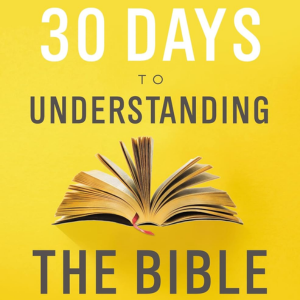
The Bible is the most influential book in human history, yet for many, it remains a daunting “closed book.” With 66 individual books, thousands of years of history, and complex cultural contexts, knowing where to start can feel impossible.
In “30 Days to Understanding the Bible, 30th Anniversary Edition,” Dr. Max Anders provides a revolutionary solution. His premise is simple: you can unlock the entire arc of the Scriptures by spending just 15 minutes a day for one month. This isn’t just a book summary; it’s a foundational blueprint for a lifetime of faith.
The Heart of the Book: Why This Matters
The primary message Max Anders wants to convey is that biblical literacy is accessible to everyone. He believes that the Bible is not a collection of disconnected stories but a singular, cohesive narrative. By mastering the “big picture”—the geography, the timeline, and the core doctrines—you move from being a confused reader to a confident student. His goal is to help you “master the Bible so well that the Bible masters you.”
Part 1: The Story of the Old Testament
The Old Testament is often where readers get lost in the weeds of genealogies and ancient laws. Anders simplifies this by focusing on the “arc” of history.
The Structure of the Bible
Anders starts by breaking down the library. The Old Testament is categorized into three main sections:
- History: 17 books (Genesis through Esther)
- Poetry: 5 books (Job through Song of Solomon)
- Prophecy: 17 books (Isaiah through Malachi)
The Geography of the Old Testament
To understand the story, you must understand the stage. Anders teaches the “C” of the Fertile Crescent, highlighting the importance of the Nile, the Jordan River, and the Sea of Galilee. Understanding where events happened makes the “why” much clearer.
The Nine Eras of Old Testament History
Anders divides the Old Testament into nine distinct eras to help you track the timeline:
- The Creation Era: The beginning of the world, the fall of man, and the flood.
- The Patriarch Era: The story of the “fathers” of the faith—Abraham, Isaac, Jacob, and Joseph.
- The Exodus Era: Deliverance from Egypt under Moses and the giving of the Law.
- The Conquest Era: Joshua leads the Israelites into the Promised Land.
- The Judges Era: A dark period of 400 years where “everyone did what was right in their own eyes,” led by figures like Gideon and Samson.
- The Kingdom Era: The rise of Saul, David, and Solomon, followed by the tragic division of the nation into Israel and Judah.
- The Exile Era: Because of disobedience, the people are carried off to Babylon.
- The Return Era: A remnant returns to Jerusalem to rebuild the Temple and the walls under Ezra and Nehemiah.
- The Silence Era: The 400-year gap between the Old and New Testaments where no prophets spoke.
The Poetical and Prophetical Books
Anders explains that these books fit into the historical timeline. The Poetical books (like Psalms) reflect the heart of the people during the Kingdom era, while the Prophetical books (like Jeremiah) are God’s warnings and promises delivered primarily during the Kingdom, Exile, and Return eras.
Part 2: The Story of the New Testament
The New Testament is the fulfillment of everything promised in the Old. Anders uses the same structural approach here.
Geography and Structure
The New Testament focuses on a smaller geographical area: Palestine and the Mediterranean world. Structurally, it consists of:
- History: The 4 Gospels and the book of Acts.
- Letters (Epistles): 21 letters written to churches and individuals.
- Prophecy: The book of Revelation.
The New Testament Eras
- The Gospel Era: The life, death, and resurrection of Jesus Christ.
- The Church Era: The birth of the church at Pentecost and its growth in Jerusalem.
- The Missions Era: The expansion of the gospel to the ends of the earth, primarily through the journeys of the Apostle Paul.
The Epistles
Anders explains that the Epistles are the “instruction manuals” for the church. They take the events of the Gospels and explain their theological significance and practical application for daily living.
Part 3: Ten Great Doctrines of the Bible
Understanding the story is one thing; understanding the meaning is another. Anders devotes a significant portion of the book to “Systematic Theology” simplified.
The Nanosummary: The Bible in a Nutshell
If you had to summarize the Bible in one sentence, Anders suggests: “God is restoring fallen humanity to Himself through the work of His Son, Jesus Christ.” The Bible begins with a garden (Eden), ends with a city (The New Jerusalem), and is held together by the Cross in the middle.
How to Master the Bible So It Masters You
This is the “why” behind the “what.” Anders argues that information without transformation is useless. He encourages a three-step process:
- Learn it: Understand the facts (the 30-day plan).
- Love it: Engage your heart with the message.
- Live it: Apply the truths to your character and actions.
The goal isn’t just to know more than your neighbor; it’s to be changed by the Author.
The Teaching Plan
The book is designed as a workbook. It uses spaced repetition, fill-in-the-blank charts, and self-tests. This makes it ideal for:
- Individual Study: 15 minutes a morning.
- Small Groups: Using the chapter reviews for discussion.
- New Believers: A perfect “on-boarding” tool for faith.
Bonus Chapters: Deepening Your Knowledge
The 30th Anniversary Edition includes expanded content that provides even more context:
- Comparison of the Four Gospels: Why we need Matthew, Mark, Luke, and John to get a full picture of Jesus.
- The Parables of Jesus: Understanding the “earthly stories with heavenly meanings.”
- Miracles in the Bible: Defending the supernatural works of God.
- Messianic Prophecies: How the Old Testament predicted Jesus with mathematical precision.
- Passover and the Lord’s Supper: Connecting the dots between the lamb’s blood in Egypt and the blood of Christ.
- The Resurrection: The historical evidence for the cornerstone of Christianity.
- Distinctiveness of Christianity: How it differs from every other world religion (Grace vs. Works).
- Literary Forms: Recognizing when you are reading history, poetry, or apocalyptic literature.
Final Review: Is it worth it?
Absolutely. Max Anders has accomplished something rare: he has made the complex simple without making it shallow. Whether you are a lifelong churchgoer who feels they’ve missed the “big picture” or a curious seeker who finds the Bible intimidating, this book is your key.
It is a masterpiece of educational design. By the end of the 30 days, you won’t just know about the Bible; you will feel like you finally know the Bible. It turns a thick, mysterious volume into an open map, ready for you to explore for the rest of your life.
FAQs
Q1. What is the main goal of “30 Days to Understanding the Bible”?
The book aims to help readers understand the overall structure, storyline, and teachings of the Bible in just 30 days through short daily lessons.
Q2. Who should read this book?
It is ideal for:
- Beginners studying the Bible
- Church study groups
- Theology students
- Anyone wanting a clear overview of Scripture.
Q3. How long does it take to complete the book?
The program is designed to take 15 minutes per day for 30 days.
Q4. Does the book explain every verse of the Bible?
No. Instead, it focuses on the big picture overview, helping readers understand the main storyline and doctrines.
Q5. Is this book suitable for beginners?
Yes. The book is specifically written for people with little or no prior knowledge of the Bible.