
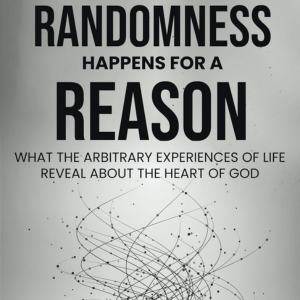
In a world obsessed with "manifesting" and "everything happens for a reason," Mitchell W. Dillon offers a refreshing, albeit challenging, perspective in his book, "Randomness Happens for a Reason: What the Arbitrary Experiences of Life Reveal About the Heart of God." If you’ve ever wondered why a freak storm ruined your wedding day while your neighbor’s party remained dry, or why tragedy strikes the faithful while the wicked prosper, this book is your roadmap. Dillon argues that randomness isn't an oversight by God—it’s a tool.
Part 1: Deconstructing the Myth of Control
1. How’d That Get In My Bucket?
Dillon opens by addressing the "buckets" of our lives. We often think we hand-pick every experience through our choices. However, life frequently dumps things in our bucket—illness, sudden financial shifts, or chance encounters—that we didn't ask for. He establishes that accepting these "uninvited guests" is the first step toward spiritual sanity.
2. Is Life Unfair Or Is It Random?
We often scream "Unfair!" when things go wrong. Dillon pivots the conversation: life isn't necessarily rigged against us; it is often just random. By distinguishing between injustice (intentional harm) and randomness (stochastic events), we can stop blaming God for "targeting" us and start seeing the mechanics of a fallen world.
3. Is The Universe Pranking Us?
When a series of unfortunate events occurs, it feels like a cosmic prank. Dillon explores the psychology of apophenia—our tendency to see patterns where none exist. He suggests that while God is sovereign, not every "bad luck" streak is a divine message written in the stars.
4. In What Sense Are God’s Ways Mysterious?
The cliché "God moves in mysterious ways" is often a cop-out. Dillon dives into the theological depth of mystery. God’s ways are mysterious not because He is hiding information, but because His perspective spans eternity while ours spans a Tuesday afternoon.
Part 2: The Mechanics of a Stochastic World
5. Has Entropy Always Reigned Supreme?
Dillon looks at the Second Law of Thermodynamics (entropy). He questions whether the "disorder" we see today was part of the original design or a result of the Fall. This chapter sets the stage for understanding how God works within the laws of physics He created.
6. What Are The Limitations Of Randomness?
Randomness is not "God." It has boundaries. Dillon argues that while the timing of an event might be random (like a leaf falling), the existence of the tree is not. God sets the parameters within which randomness operates.
7. How Important Is An Unbiased Worldview?
To see God clearly, we must strip away our biases about how we think the world should work. Dillon challenges the reader to look at reality without the "prosperity gospel" lens that expects constant rewards for good behavior.
8. Can There Be Meaning In A Random World?
If a car accident is "random," does it lose its meaning? Dillon argues no. Meaning isn't found in the cause of the event, but in the Redeemer of the event. God doesn't need to cause a tragedy to use it for a profound purpose.
Part 3: Debunking Religious Superstitions
9. Does God Trade Favors?
This is a hard-hitting chapter on the "transactional" nature of modern faith. Dillon asserts that God is not a vending machine where you insert "prayer coins" to receive "blessing snacks."
10. Why The Curious Resistance To Randomness?
Humans hate randomness because it implies a lack of control. Dillon explores why religious people, in particular, struggle with the idea that some things just happen, preferring instead to believe every flat tire is a spiritual attack.
Part 4: The Twelve Purposes of Randomness
In this pivotal section (Chapters 11–20), Dillon outlines why God allows randomness to exist in His governed universe.
11. To Postpone God’s Judgment: If every sin was met with immediate lightning, there would be no room for grace or the choice to repent.
12. To Render Life Pointless: Without God, randomness makes life "a tale told by an idiot." Dillon shows how randomness highlights our need for a higher narrative.
13. To Drive Out Fear: If we realize that God is with us in the random storm, we stop fearing the storm itself.
14. To Test Our Faith: Genuine faith isn't trusting God when the path is clear; it’s trusting Him when the path makes no sense.
15. To Affirm God’s Authority: God’s ability to weave random threads into a tapestry proves His supreme power.
16. To Spotlight Jesus: In a chaotic world, the consistency of Christ becomes the only "fixed point."
17. To Accommodate the Sufferings of Christ: We share in His sufferings when we face a world that is "out of joint."
18. To Cultivate Spiritual Maturity: Chaos forces us to grow roots that aren't dependent on "good vibes."
19. To Press For A Decision: The unpredictability of life reminds us that "tomorrow is not guaranteed," forcing us to decide where we stand with God today.
20. When God Doesn't Care: A provocative title where Dillon explains that God doesn't care about our comfort as much as He cares about our character.
Part 5: Historical and Biblical Perspectives
21. That Time Spurgeon Backpedaled: Dillon highlights a moment in the life of the "Prince of Preachers," Charles Spurgeon, where he had to reconcile his strict views on sovereignty with the messy reality of human suffering. It’s a lesson in humility for any theologian.
22. Creation’s Choreographer: Dillon uses the metaphor of a choreographer to describe God. He isn't micro-managing every atom's vibration, but He is directing the overall "dance" of history toward a glorious conclusion.
23. Jesus’ Odd Take On Tragedy: Looking at Luke 13, Dillon analyzes Jesus’ response to those who died when the Tower of Siloam fell. Jesus didn't say they were "worse sinners"; He pointed to the randomness of the event as a call for everyone to repent.
24. The Divine Supply Chain: How does God provide? Often through seemingly random connections. Dillon explains that God uses the "logistics" of a random world to deliver precisely what His children need at the right time.
Part 6: Practical Application
25. Prayer For Dummies: If the world is random, why pray? Dillon argues that prayer isn't about changing the "randomness" as much as it is about aligning our hearts with the "Reason" behind the randomness.
26. Satisfaction Guaranteed: Dillon explores how true satisfaction comes from resting in God's character, not in our ability to predict the future.
27. Game-Ready: Life is like a game where the rules are set, but the plays are unpredictable. Being "game-ready" means having a spiritual foundation that isn't shaken when the "ball" takes a weird bounce.
28. The Recipe For Mice: Using historical "spontaneous generation" myths (like the idea that dirty rags create mice), Dillon mocks the idea that life creates itself. He reinforces that behind the "chaos" is a Master Designer.
29. Misery Loves Company: A look at the community aspect of suffering. Randomness strikes everyone; therefore, we are all in the same boat, which should lead to greater empathy within the Church.
30. Putting On Our Big Boy Pants: The final call to maturity. Dillon encourages readers to stop asking "Why me?" and start asking "What now, Lord?" It’s an invitation to spiritual adulthood.
Addendum: A Concise Paraphrase of Job's Story
Dillon concludes with the story of Job—the ultimate "victim" of what seemed like cosmic randomness. Job loses everything, his friends offer terrible "everything happens for a reason" advice, and God finally shows up. God doesn't explain why it happened; He explains who He is.Job’s story teaches us that we don't need an explanation for the chaos if we have a revelation of the Creator.
The Core Message: What Mitchell W. Dillon Wants You to Know
The central thesis of "Randomness Happens for a Reason" is that God’s sovereignty and life’s randomness are not mutually exclusive.
Dillon wants to convey that:
Randomness is a Created Tool: God uses the "noise" of life to create a "signal" of faith.
Freedom Requires Unpredictability: For human will to be free and for faith to be genuine, the world cannot be a strictly deterministic machine where every "good" act gets an immediate "cookie."
The Heart of God is Constant: Even when circumstances are arbitrary, God's love is intentional.
By the end of the book, the reader is left with a profound sense of peace. We no longer have to live in fear of the "next bad thing" or feel guilty that our "lack of faith" caused a random misfortune. Instead, we can look at the chaos and say, "I don't know why this happened, but I know the One who is using it."
Final Review
This book is a must-read for anyone deconstructing a "health and wealth" background or anyone struggling to find God in the midst of a chaotic life. It is intellectually rigorous yet deeply pastoral.Key Takeaway: Stop looking for a "reason" in every accident, and start looking for the "Redeemer" in every moment.
Frequently Asked Questions
Q1. Does "Randomness Happens for a Reason" argue that God is not in control?
Not at all. Mitchell W. Dillon argues that God is fully sovereign, but He has designed a world where randomness exists as a tool. The book suggests that God’s authority is displayed in His ability to orchestrate a world that includes unpredictable, stochastic events without losing control of the ultimate outcome.
Q2. What is the "Divine Supply Chain" mentioned in the book?
The "Divine Supply Chain" is Dillon's way of explaining how God provides for our needs. Instead of magic, God often uses the complex, seemingly random intersections of people, timing, and events to deliver precisely what is needed, showing His hand at work within the natural order of the world.
Q3. Why does the author think humans resist the idea of randomness?
The book posits that humans have a "curious resistance" to randomness because it threatens our sense of control. We prefer to believe in "karma" or direct cause-and-effect because it makes the world feel predictable. Acknowledging randomness requires a deeper, more uncomfortable level of trust in God’s character rather than our own understanding.
Q4. How does the story of Job relate to the book's message?
Dillon uses Job’s story to show that when tragedy strikes, we often waste energy looking for a specific "sin" or "reason" to explain it. Just as God didn't give Job a list of reasons but instead revealed His own magnitude, the book encourages us to find peace in the Creator rather than an explanation for the chaos.
Q5. Is this book a critique of the "Prosperity Gospel"?
Yes. A major theme is debunking the idea that God "trades favors" or acts as a vending machine. By highlighting that life is often random and "unfair," Dillon challenges the theology that suggests faithful people are guaranteed health, wealth, and safety, pointing instead toward spiritual maturity and endurance.