
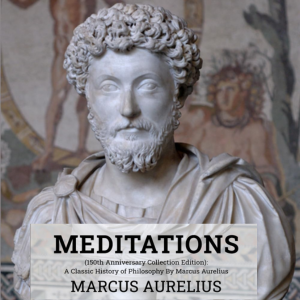
In the quiet hours before the dawn of the Roman Empire’s most turbulent days, a man sat in his tent, not plotting conquests, but questioning the nature of his own soul. This man was Marcus Aurelius, the last of the "Five Good Emperors." His private journals, never intended for public eyes, have survived nearly two millennia to become one of the most influential works of Stoic philosophy in history: Meditations.
This 150th Anniversary Collection Edition serves as a bridge between the ancient world and the modern psyche. It is not just a book; it is a spiritual exercise.
The Core Message: What Marcus Aurelius Wants to Convey
If we were to distill the thousands of words in Meditations into a single heartbeat, it would be this: Control your perceptions, act for the common good, and accept the nature of the universe with equanimity.
Aurelius argues that while we cannot control external events—plagues, wars, or the betrayal of friends—we have absolute sovereignty over our internal response. He views the human mind as an "Inner Citadel," a fortress that can remain unshakeable regardless of the storms raging outside. His message is one of radical responsibility and profound humility.
A Deep Dive into the 12 Books (Chapters)
Unlike a modern textbook, Meditations is organized into twelve "Books." Each serves as a chronological or thematic layer of Marcus’s self-improvement.
Book 1: Debts and Lessons
Marcus begins not with philosophy, but with gratitude. He lists his family, teachers, and mentors, noting the specific virtues he learned from each.
From his grandfather: Decency and a mild temper.
From his mother: Piety, generosity, and a simple way of living.
From Antoninus Pius (his predecessor): Constancy, dignity, and a lack of vanity.
The Lesson: We are a mosaic of those who influenced us. Recognizing our "debts" keeps the ego in check.
Book 2: On the River Granua
Written while on campaign against the Quadi, this book focuses on the reality of mortality and the importance of the present moment.
Morning Ritual: Marcus famously tells himself to expect to meet "the busybody, the ungrateful, the arrogant." By anticipating human flaws, he protects his own peace.
The "Now": He reminds himself that even if he lived three thousand years, he could only lose the moment he is currently living.
Book 3: The Inner Life
Marcus explores the concept of the "Ruling Faculty" (hegemonikon).
Integrity: He stresses that a man should never do anything that would make him lose self-respect.
The Purpose of Life: To live in accord with nature. For a human, "nature" means being rational and social. If an action isn't both, it is a betrayal of one's design.
Book 4: The Universe as a City
This chapter introduces the "Cosmopolitan" view of Stoicism.
Interconnectedness: Marcus views the world as a single living entity. If something harms the hive, it harms the bee.
Change is Neutral: He reflects on how everything is in a state of flux. To fear change is to fear the very process that created you.
Book 5: The Duty to Wake Up
Perhaps the most relatable chapter for modern readers, Book 5 begins with Marcus arguing with himself about getting out of bed.
Work as Nature: He tells himself that even plants and birds do their jobs; surely an Emperor can do his.
Self-Sufficiency: He notes that "the mind is the master of its own masters." You don't need the applause of others to be a good person.
New Age Spirituality: A Deep Dive into the Uncharted Territory of the Sacred
Book 6: The Harmony of the Whole
Marcus focuses on the Logos—the underlying logic of the universe.
Acceptance: He posits that we are like wrestlers. If our opponent scratches us, we don't hate them; we simply stay on guard. Similarly, we should navigate life's obstacles without resentment.
Simplicity: He reminds himself that even the finest purple robes are just "sheep's wool dyed with the blood of a shellfish." This practice of "stripping things bare" helps him avoid being dazzled by wealth.
Book 7: Patience and Persistence
This chapter is a collection of shorter, punchier aphorisms.
The Obstacle is the Way: Marcus writes that "the impediment to action advances action. What stands in the way becomes the way." This has become the rallying cry for modern Stoics.
Forgiveness: He emphasizes that those who do wrong do so out of ignorance of good and evil. Therefore, they deserve pity, not anger.
Book 8: The Requirements of a Happy Life
Marcus reflects on his role as a leader and a student of philosophy.
No Regrets: He notes that repentance is a "reproach of the conscience for having let something useful go by."
Body vs. Mind: He continues to separate the physical sensations of pain from the mind's judgment of that pain.
Book 9: Justice and Sincerity
For Marcus, Justice is the highest virtue.
Omission as Sin: He notes that you can commit an injustice by doing nothing just as easily as by doing something.
Truthfulness: To lie is to be out of sync with the nature of reality.
Book 10: The Maturity of the Soul
This chapter is a stern self-critique.
Stop Talking, Start Being: "Waste no more time arguing about what a good man should be. Be one."
Wholeness: He urges his soul to become "solid and one," rather than fragmented by desires.
Book 11: The Rational Soul
Marcus discusses the qualities of the "rational soul," including self-perception, self-analysis, and the ability to reach its own goals regardless of where life ends.
The Stoic Script: He compares life to a play. Whether the play is three acts or five is up to the playwright (Nature). Your job is only to play your part well.
Book 12: The Final Reflection
The concluding book is a meditative preparation for death.Release: He views death not as an end, but as a "discharging" of elements back into the universe.
The Three Parts: Man is made of Body, Breath, and Mind. Only the Mind is truly yours. If you focus on the Mind, the other two cannot touch your happiness.
Why the 150th Anniversary Collection Edition Matters
This specific edition is curated to highlight the historical context of the Antonine Plague and the Marcomannic Wars. Reading Marcus’s words while knowing he was writing them during a global pandemic and constant border conflicts makes his call for inner peace even more poignant.
Key Philosophical Themes to Remember
Amor Fati (Love of Fate): Don’t just endure your life; embrace it. Everything that happens is "knitted" into the fabric of your existence.
Memento Mori (Remember You Must Die): This isn't morbid; it's a tool for prioritization. If you died tomorrow, would you care about that Twitter argument today?
The Dichotomy of Control: Distinguish between what is "up to us" (opinions, intentions, desires) and what is "not up to us" (reputation, weather, other people's actions).
How to Read "Meditations" for Maximum Impact
You shouldn't read Meditations like a novel. It is meant to be chewed on.
Read one passage a day: Marcus wrote these as "reminders" to himself. Treat them as daily prompts for your own journaling.
Apply the "View from Above": Whenever you feel stressed, imagine yourself looking down from the clouds, seeing the vastness of the earth and the billions of people who lived and died before you. Your problems will suddenly seem much smaller.
Focus on Action: Philosophy, for Marcus, was not an academic subject. It was a craft, like carpentry. The goal is to build a better life, not a better library.
Final Review: A Timeless Blueprint
Meditations by Marcus Aurelius remains the ultimate "self-help" book because it asks for nothing but your own effort. It doesn't promise wealth or fame—in fact, it warns against them. Instead, it promises something much rarer: freedom.
In a world of constant distraction and "outrage culture," the 150th Anniversary Collection Edition is a cold glass of water for a feverish soul. It reminds us that no matter what happens in the White House, the stock market, or our social feeds, we remain the masters of our own minds.
"The happiness of your life depends upon the quality of your thoughts." — Marcus Aurelius
Whether you are a CEO, a student, or someone simply trying to find their footing in a chaotic world, the Emperor’s journals offer a timeless roadmap toward a life of purpose, dignity, and peace.
FAQs
1. What is the main core message of Meditations by Marcus Aurelius?
Marcus Aurelius wrote Meditations as a personal journal focused on mastering your mind, accepting the universe, and acting for the common good. Its primary core message is that while you cannot control external events, you hold complete power over your internal reactions. Building this "Inner Citadel" gives you true emotional freedom, no matter how chaotic life gets around you.
2. Why is Meditations considered a classic of Stoic philosophy?
Meditations is a foundational cornerstone of Stoic philosophy because it offers real-world reflections from a ruling Roman Emperor rather than theoretical concepts. Written during times of war and pandemic, Marcus Aurelius outlines core Stoic principles like Amor Fati (loving your fate), Memento Mori, and the Dichotomy of Control, making it a timeless self-improvement blueprint.
3. How can reading Meditations help with modern stress and anxiety?
In today's fast-paced world of constant distractions and outrage, Meditations provides mental clarity and resilience. Marcus Aurelius reminds us to focus strictly on what is within our control and let go of what is not. By viewing daily obstacles as opportunities for personal growth, you can reduce anxiety and maintain a peaceful state of mind.
4. How is the 12-book structure of Meditations organized?
Meditations is divided into twelve thematic books, each acting as a personal layer of self-reflection and spiritual growth. Marcus Aurelius covers essential topics like gratitude, duty, the reality of mortality, justice, and the nature of the rational soul. Together, these twelve books offer a comprehensive guide to building character and living in harmony with nature.
5. How should beginners approach reading Meditations for maximum impact?
You shouldn't rush through Meditations like a standard book. Instead, read one entry or passage a day, treat it as a daily mindfulness prompt, and reflect deeply on its meaning. Focus on applying the Stoic principles into daily actions, like practicing gratitude and zooming out to see the bigger picture, rather than just treating it as academic reading.