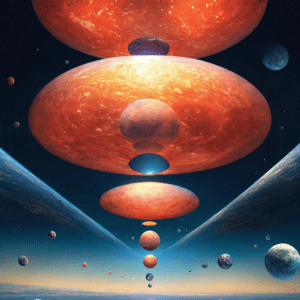
String Theory, a fundamental concept in Hinduism, encompasses various dimensions and realms known as Lokas. These Lokas are not only essential in Hindu mythology but also hold significance in the realm of theoretical physics. Exploring the 14 Lokas within the framework of String Theory provides insights into the intricate connections between spirituality and science. In the vast expanse of Hindu cosmology, the 14 Lokas shimmer like celestial jewels. Join us on a voyage beyond time and space as we unravel their secrets.
Hinduism, a religion steeped in rich philosophical and cosmological traditions, offers a unique perspective through the concept of the 14 lokas. Often translated as “realms” or “worlds,” these lokas represent not just physical locations but also states of being and consciousness.
To travel through these cosmic dimensions, one doesn’t need a spaceship; you simply need to look inward and learn how to connect with yourself spiritually through deep meditation.
Table of Contents
ToggleUnderstanding Lokas in Hinduism
What are Lokas?
Lokas, in Hinduism, refer to different planes of existence or realms. They represent various levels of consciousness and spiritual evolution. These Lokas are interconnected and inhabited by different beings, each with its own characteristics and purposes.
Significance of Lokas in Hindu Mythology
In Hindu mythology, Lokas are depicted as celestial worlds, each governed by specific deities and principles. They symbolize the cosmic order and the interconnectedness of all existence. Understanding Lokas is crucial for comprehending the complex cosmology of Hinduism.
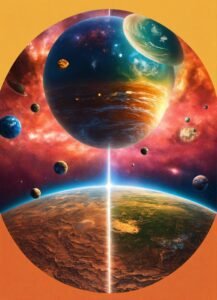
Understanding String Theory
While not directly equivalent to the 14 lokas, a fascinating parallel can be drawn with string theory, a theoretical framework in modern physics. String theory proposes that the fundamental building blocks of the universe are not point-like particles, but rather tiny, vibrating strings existing in multiple dimensions. This concept of multiple dimensions, though hypothetical in the realm of physics, resonates with the idea of various lokas within Hinduism, suggesting a deeper understanding of the universe beyond our everyday perception.
The 14 Lokas in String Theory: A Celestial Symphony
In Hindu cosmology, the concept of “Lokas” holds a significant place. These Lokas represent various planes of existence that comprise the vast and intricate structure of the universe. Each Loka has its own distinctive attributes, inhabitants, and purpose. Let’s explore this celestial symphony:
The 14 lokas can be broadly categorized into three regions:
- Upper Lokas (Bhuloka to Satyaloka):These seven realms represent the physical and spiritual planes accessible to embodied beings.
- Middle Lokas (Maharloka to Brahmaloka):These four realms are associated with higher planes of existence and subtle dimensions.
- Lower Lokas (Atala to Patala):These three realms represent the subterranean world, often associated with darkness and negative energies.
If the lower Lokas represent denser, chaotic vibrations, it becomes vital to regularly cleanse negative energy from your body and mind to keep your spiritual frequency light and elevated.
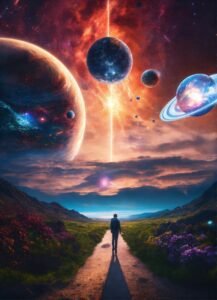
14 Lokas
Satyaloka (Brahma Loka):
Satyaloka is the highest Loka (Realm), where Sri Chatur Mukha Brahma resides, the creator of the universe. Souls released from the cycle of rebirth find liberation here. It represents the realm of ultimate truth and spiritual realization.
Altering your perception of time across these dimensions begins with stilling the mind, which you can easily practice using a complete meditation guide for beginners.
Tapoloka:
Tapoloka is the abode of ascetics and great sages who seek spiritual enlightenment through austerity and meditation. A realm of deep meditation and profound wisdom.
Janaloka:
Janaloka is where great saints and enlightened beings reside, devoted to the pursuit of knowledge and wisdom. Intellectual and spiritually enlightened beings reside here.
Maharloka:
Maharloka is inhabited by celestial beings and sages who assist in the governance of the universe. It is a realm of spiritual contemplation. Ascetics and seekers of inner truth find solace here.
Svargaloka (Indra Loka):
Svargaloka is the heavenly abode of the gods (celestial beings), including deities like Indra and Agni, who preside over various aspects of the cosmos. It is often associated with pleasure and prosperity. It is a realm of pure light, divine energy, and celestial entities.
Bhuvarloka:
Bhuvarloka is An intermediary region between earthly and celestial planes, where humans and mortal beings reside, experiencing the cycle of birth and death. Celestial beings and subtle energies dwell here.
Bhuloka (Earthly Realm):
Bhuloka is the physical plane of existence, encompassing the material world and the five elements. It is our familiar world, where human experiences unfold. It is the plane of actions, karma, and spiritual growth.
Atala:
Atala is one of the lower Lokas, characterized by opulence and luxury, but also by materialism and indulgence. It is associated with desire and sensuality. Inhabitants are driven by materialistic and selfish desires.
Vitala:
Vitala is the Loka inhabited by demons and malevolent beings with dominant natures, representing the darker aspects of existence. It is characterized by power and control.
Sutala:
Sutala is ruled by the demon king Bali, known for his devotion and generosity, despite his demonic lineage. Opulence and beauty coexist here.
Talatala:
Talatala is a realm of wealth and prosperity, associated with arrogance and egotism, the serpent deity Vasuki. Beings with a strong sense of self-importance inhabit it.
Mahatala:
Mahatala is a deeper layer of existence, the abode of Nagas, serpent beings who guard the treasures of the earth. It is obscured by darkness and mystery.
Rasatala:
Rasatala is a Loka marked by chaos and conflict, filled with serpents and demons, representing the primal forces of creation and destruction. A realm where inner struggles manifest.
Patala:
Patala is the lowest Loka, shrouded in secrecy, inhabited by powerful demons and serpents, representing the depths of existence.
Symbolism and Interpretations of Lokas
The Lokas symbolize the different levels of consciousness and spiritual evolution. They also represent the interconnectedness of the universe and the eternal cycle of creation, preservation, and destruction.
Connection to String Theory
In String Theory, the concept of multiple dimensions and parallel universes parallels the idea of Lokas in Hinduism. The intricate vibrations of strings in String Theory resonate with the diverse energies and frequencies associated with each Loka.
Just as String Theory implies everything is made of vibrating energy, practicing ancient spiritual habits that change your life can deliberately elevate your personal frequency to tap into higher states of awareness.
Related Articles

Beyond the 14 Lokas
While the 14 lokas provide a framework for understanding the different levels of existence, it’s important to remember that they are not a rigid hierarchy. The journey through these lokas is ultimately a symbolic representation of the soul’s evolution towards liberation (moksha). As souls journey across these Lokas, their karmic actions determine their ascent or descent. Just as the sun rises and sets, beings traverse the cosmic ladder, seeking enlightenment, liberation, or fulfillment of desires.
The Intriguing Parallels with String Theory
The concept of multiple dimensions in string theory finds an interesting resonance with the idea of lokas in Hinduism. Both suggest a reality beyond our three-dimensional perception, hinting at a vast and multifaceted universe waiting to be explored. While one is a scientific framework and the other a philosophical concept, the convergence in their propositions sparks curiosity and invites further investigation.
Conclusion
The exploration of the 14 Lokas within the framework of String Theory offers a fascinating perspective on the convergence of spirituality and science. The 14 lokas of Hinduism offer a profound and multifaceted way of understanding the cosmos and our place within it. By exploring these realms, we gain a deeper appreciation for the complexities of existence, the potential for spiritual growth, and the interconnectedness of all things. While the 14 lokas may not be a scientific theory, they offer a rich tapestry of metaphors and symbolism that continues to inspire introspection and philosophical exploration.
Frequently Asked Questions
Q: How do the 14 Lokas in Hinduism relate to modern String Theory?
A: In Hindu cosmology, the universe consists of 14 Lokas, which are distinct realms or planes of existence. Modern String Theory similarly suggests that our universe is made up of multiple hidden, extra dimensions beyond what we can perceive. Both frameworks propose that reality is a multi-dimensional structure where different realms exist simultaneously, separated only by their specific frequencies.
Q: What are the upper and lower realms of the 14 Lokas?
A: The cosmic structure is divided into seven upper realms (Vyahrtis) and seven lower realms (Patalas). The upper worlds, culminating in Satyaloka, represent higher spiritual dimensions and advanced states of consciousness. The lower netherworlds reflect denser material planes. This hierarchy beautifully mirrors the concept of varying dimensional planes discussed in advanced quantum physics and String Theory.
Q: Does time flow differently across the Hindu 14 Lokas?
A: Yes, absolutely! Ancient Vedic texts explicitly state that time is relative. For instance, a mere moment in Satyaloka equals millions of years on Earth (Bhuloka). This ancient scriptural depiction of time dilation aligns perfectly with Einstein’s relativity and modern cosmic theories, showing how time alters across different dimensions or higher 14 Lokas.
Q: Are the 14 Lokas actual physical places or states of consciousness?
A: They are actually both! While described as distinct cosmic planes, Vedic wisdom explains that the 14 Lokas correspond directly to your internal state of consciousness and karmic vibration. In the context of String Theory, you can think of them as different vibrational frequencies. When your consciousness shifts and vibrates at a higher frequency, you naturally align with a higher dimensional realm.
Q: Why is the intersection of Hinduism and String Theory becoming popular?
A: People are fascinated to discover that ancient sages mapped out a complex multiverse long before modern physics did. By studying the 14 Lokas alongside String Theory, we bridge the gap between ancient mysticism and quantum mechanics. It proves that what ancient texts described as spiritual realms closely mirrors what physicists now call mathematical, higher-dimensional realities.